Some rescue stories don’t need loud moments to feel powerful.
They unfold in silence.
In small shifts.
In the way a dog finally exhales after not feeling safe for a long time.
That’s what makes this deaf rescue pup’s story so moving.
The video shows a deaf dog who had spent much of her early life navigating a world she couldn’t fully hear — and likely couldn’t fully trust either — slowly learning what safety feels like in a foster environment where patience replaced pressure.
At first, she’s cautious.
Watchful.
Carefully observing everything through sight and vibration rather than sound, as deaf dogs often rely heavily on visual cues and touch to interpret their surroundings.
But the most striking part of the video isn’t fear.
It’s what happens when calm enters the picture.
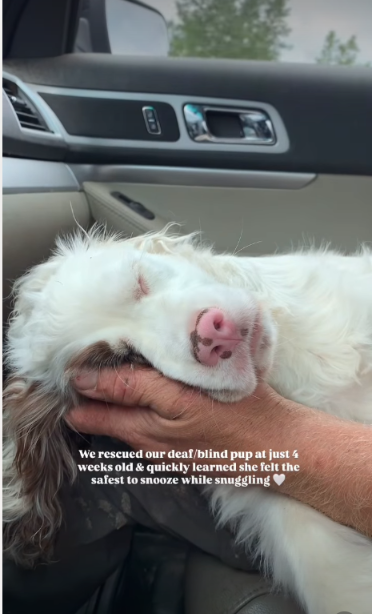
When a kind human sits nearby, the dog begins to relax in a way that’s almost imperceptible at first — a softer posture, slower movement, and a willingness to stay close rather than retreat.
Over time, that closeness becomes comfort.
And comfort becomes trust.
Deaf rescue dogs often experience the world differently than hearing dogs, especially in unfamiliar environments like shelters or new foster homes.
Without sound as a guiding anchor, they depend heavily on consistency, body language, and emotional energy from the people around them.
When that energy is calm, they tend to mirror it back.
That’s exactly what happens here.
The dog gradually begins to settle into contact, leaning into gentle presence rather than pulling away.
There’s no sudden breakthrough moment — just a steady easing of tension, as if her nervous system is finally recognizing that nothing bad is going to happen.
This kind of transformation is something rescue workers see often with deaf or sensory-limited dogs once they are placed in stable, predictable environments.
When communication becomes visual and tactile instead of auditory, trust can develop just as strongly — sometimes even more deeply — because it relies on presence rather than noise.
Animal behavior experts note that consistent, low-stress interaction helps anxious rescue dogs regulate their emotional state, especially those with heightened sensitivity due to early life instability or sensory differences.
And in this case, the change is visible.
The once-tense posture softens.
The hesitation fades.
The dog begins choosing closeness instead of distance.
That shift matters more than it might look like on screen, because for a dog that has learned to navigate the world without sound, safety isn’t about what she hears — it’s about what she feels.
Stable hands.
Predictable movement.
A calm presence that doesn’t disappear.
Viewers responding to the video were quick to point out how emotional the transformation felt.
Many shared that watching a deaf rescue dog relax into trust highlights just how powerful non-verbal communication can be between humans and animals.
Because at its core, that’s what this story is about.
Not disability.
Not limitation.
But adaptation.
And connection.
By the end of the clip, the dog is no longer scanning for uncertainty in the same way. She’s present. Grounded.
More willing to stay in the moment instead of preparing for the next unknown.
It’s not a dramatic change.
It’s a quiet one.
But for a rescue dog learning safety for the first time, that quiet is everything.
And sometimes, that’s what healing looks like:
Not a breakthrough you can hear…
But a calm you can finally see.