Some bonds don’t need training.
They just happen the moment two lives meet.
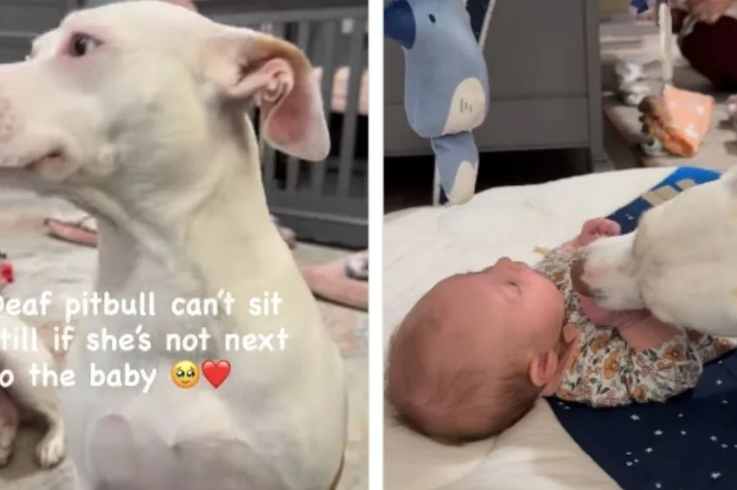
That’s exactly what people noticed in a heartwarming video of a rescue dog who has formed an unbreakable attachment to a baby in her new home.
From the very beginning, the dog shows one clear preference: she doesn’t want distance.
Not even a little.
She stays close to the baby at all times — watching, following, and gently repositioning herself whenever space opens between them.
Whether the baby is resting, being held, or simply nearby, the dog seems determined to remain part of that moment.
It isn’t frantic or anxious behavior.
It’s steady.
Intentional.
Almost like she’s quietly assigned herself a role.
Observers quickly pointed out how the dog consistently chooses proximity over independence. If the baby is on a couch, she’s nearby.
If the baby is in a caregiver’s arms, she positions herself where she can still see and feel connected.
If the baby is sleeping, she stays close enough to keep watch.

What stands out most is the calmness behind it.
There’s no stress in her movements — just focus and attachment.
And that’s a pattern often seen in dogs with strong caregiving instincts, especially rescue dogs who form deep attachments once they find safety and consistency.
In stable environments, some dogs naturally shift into protective or nurturing roles, particularly around infants, where they perceive vulnerability and respond with proximity and attention.
In this case, the dog appears to have decided, in her own way, that the baby is her responsibility.
Not in a trained sense.
In a bonded sense.
She doesn’t just tolerate the baby’s presence — she actively centers her behavior around it.
The baby becomes the focal point of her environment, and everything else is secondary.
Moments like this often resonate strongly online because they mirror a very simple emotional idea: unconditional attachment.
Viewers described the dynamic as “adorable,” “protective,” and “inseparable,” with many noting how natural the interaction feels — as if the dog didn’t need time to adjust because she already knew where she belonged.
But beyond the emotion, there’s also something practical happening.
Dogs often seek closeness to infants because of scent, sound, and routine.
Babies represent constant activity and attention in a household, and many dogs respond by integrating themselves into that rhythm.
Over time, that presence can develop into consistent companionship behavior, especially in dogs that are naturally social or have strong bonding tendencies.
Still, what makes this situation stand out is the consistency.
It’s not occasional interest.
It’s continuous closeness.
A pattern of choosing the baby, again and again, in every setting.
And while every dog-baby relationship still requires supervision and boundaries in real-world settings, moments like this highlight something people rarely miss:
Sometimes, trust doesn’t need to be built slowly.
Sometimes, it shows up immediately — in the form of a quiet shadow that simply refuses to leave a tiny human’s side.