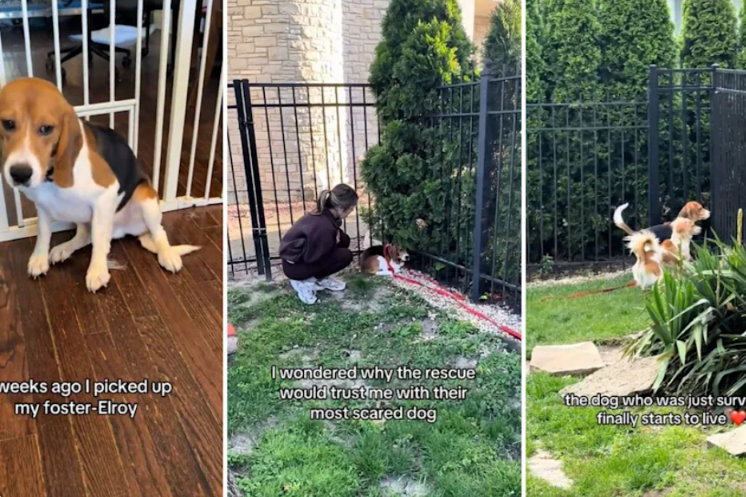
When Elroy first arrived at his foster home, his new family wasn’t sure they could help him.
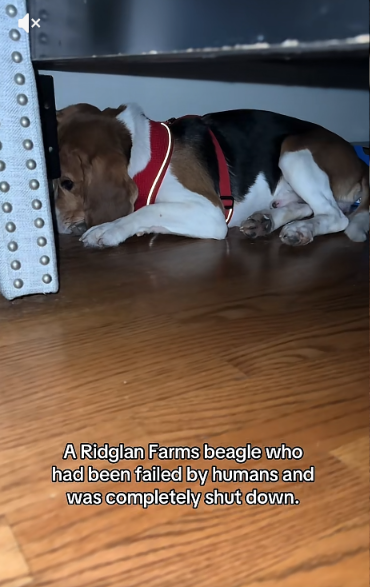
The Beagle had come from the now-shuttered Ridglan Farms breeding and research facility, and by the time he entered foster care, he was so fearful that he had almost completely shut down.
Instead of greeting his new surroundings with curiosity, Elroy seemed overwhelmed by them.
His foster parent admitted that, from the moment they brought him home, they wondered why they had been trusted with such a frightened dog.
But then something beautiful began to happen.
Slowly, quietly, Elroy started to change.
His journey didn’t happen overnight. There was no dramatic moment when he suddenly transformed into a confident, playful dog. Instead, his progress came through tiny victories that might have seemed insignificant to someone else.
For Elroy, they meant everything.
He began eating cheese.
He started spending time outdoors.
He gradually became comfortable enough to accept gentle pets.
Little by little, the world seemed to become less frightening.
An update shared by his foster family captured those changes, showing Elroy becoming more engaged and less withdrawn as the weeks passed.
The difference was subtle at first, but with each new glimpse of him, there seemed to be a little more life in his expression.
Eight weeks of patience had started to make a difference.
For dogs who have experienced neglect, stressful environments, or limited socialization, adjusting to ordinary life can take considerable time. A home may offer safety, food, and warmth, but that doesn’t automatically erase everything an animal has experienced.
Some dogs need to learn that a human hand can be gentle.
They need to discover that food will keep coming.
They need to understand that a door closing doesn’t mean they have been abandoned.
And sometimes, they simply need permission to move at their own pace.
That’s what makes Elroy’s progress so meaningful.
His foster family didn’t expect an instant transformation. Instead, they celebrated the small moments—the cheese, the outdoor adventures, the gentle affection, and every sign that he was becoming a little more comfortable.
Those moments can be easy to overlook.
But for a fearful rescue dog, they can represent enormous steps forward.
Elroy’s story also highlights the importance of foster homes. Shelters and rescue organizations provide essential care, but a calm home environment can give a frightened dog the opportunity to decompress and reveal more of their personality.
Once a dog begins feeling safe, foster families can better understand what makes them comfortable, what frightens them, and what kind of forever home might suit them.
And Elroy’s foster parent discovered something particularly rewarding: the dog they initially feared they couldn’t help was beginning to bloom right in front of them.
His transformation wasn’t about becoming a completely different dog.
It was about finally seeing more of the dog who had been there all along.
Every bite of cheese, every moment outside, and every gentle touch represented another reason for Elroy to trust the world around him.
For his foster family, watching those changes unfold became an incredibly meaningful experience.
And for Elroy, it meant discovering that life could contain more than fear.
There could be comfort.
There could be kindness.
There could be people willing to wait.
Most importantly, there could be hope.
Elroy’s journey is a beautiful reminder that rescue doesn’t always produce instant happy endings. Sometimes, the most powerful transformations happen slowly, one tiny victory at a time.
And sometimes, all a frightened dog needs is someone patient enough to stay long enough to see them bloom.