It started like any ordinary walk.
A man out with his two dogs, enjoying a normal morning routine. Leashes steady. Pace relaxed. Nothing unusual in sight.
Until a rabbit suddenly appeared.
It didn’t pause.
It didn’t hesitate.
It just ran straight past them at full speed — the kind of sudden blur that instantly changes the energy of everything around it.
And in that moment, the entire walk shifted.
At first, it looked like a simple wildlife encounter. A quick crossing of paths. Maybe a startled animal.
But then the real reason became clear.
The rabbit wasn’t just running.
It was being chased.
Somewhere behind it, a predator had been in pursuit, turning what should have been a quiet morning into a high-stakes escape sequence.
The rabbit’s path made sense only once you realized it wasn’t random — it was survival.
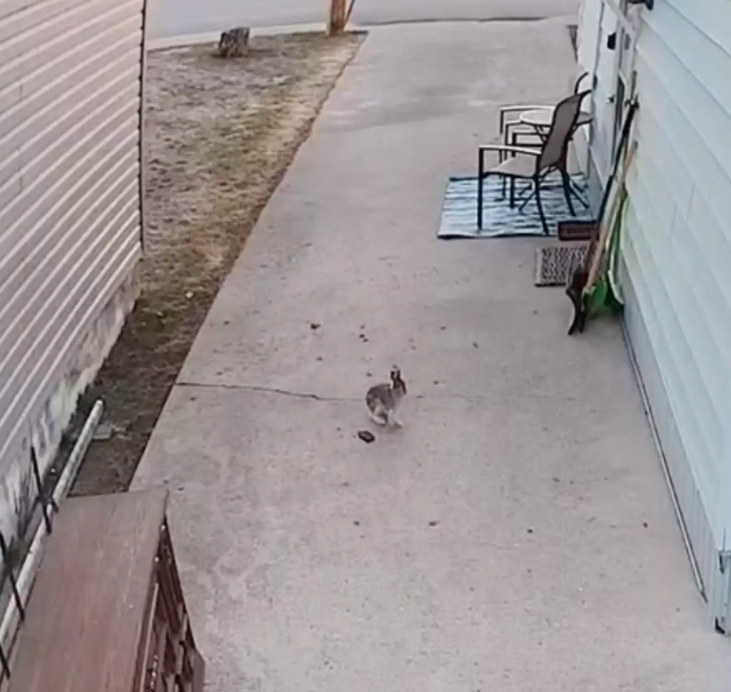
And for a brief moment, the dogs and their owner were suddenly part of that equation.
The chase unfolded in split seconds of movement and instinct.
The rabbit shot forward, threading through space with sharp, unpredictable turns — the kind of evasive motion prey animals rely on when speed alone isn’t enough.
Predators behind it adjusted instantly, recalculating, reacting, pushing forward with pursuit energy that matched the urgency of the situation.
And just like that, a normal walk became something closer to a nature documentary happening in real time.
What makes moments like this so striking is how quickly roles shift.
One second you’re a bystander.
The next, you’re standing inside a living chain of instinct: pursuit, escape, survival.
The man later reflected that he had no warning — just the sudden realization that what he was witnessing wasn’t random movement, but a coordinated chase already in progress before it ever reached him and his dogs.
The rabbit’s strategy, intentional or not, seemed to use every advantage available — speed, agility, and unpredictable direction changes.
That kind of movement is often what allows prey animals to break line-of-sight and create enough distance to escape a pursuing predator.
And in this case, it worked.
The rabbit managed to get through the encounter and continue onward, leaving the scene as quickly as it had arrived.
What remained was the aftermath — the sudden quiet that follows an adrenaline spike, when everything returns to normal but your mind is still catching up to what just happened.
The dogs, the owner, the road, the morning air — all of it unchanged, yet somehow completely different than it had been moments earlier.
Because once you witness something like that up close, even briefly, it reframes what a “walk” actually is.
It’s not just routine.
It’s exposure to a world that is always happening just outside human planning — where every rustle, every movement, every flash of motion can carry a story of survival already in progress.
And in this case, a simple rabbit crossing the path turned out to be exactly that.
A reminder that in nature, even ordinary moments are rarely ordinary for long.