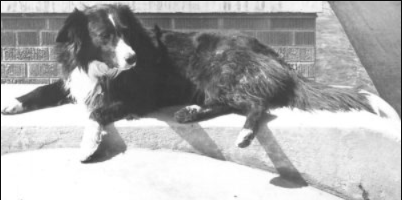
Some dogs find a family.
Others find a purpose.
And every once in a while, a dog becomes something much bigger—a local legend whose story continues to be told decades later.
That was the case for Shep, a scruffy stray who wandered onto a construction site in Colorado in the early 1950s and somehow managed to capture the hearts of an entire community.
By the time his life was over, thousands of people knew his name, motorists looked forward to seeing him on their daily commutes, and his memory had become part of local history.
It all began during the construction of the Denver-Boulder Turnpike.
As workers built what would become a major roadway connecting Denver and Boulder, a young mixed-breed dog started hanging around the construction crews.
Nobody knew exactly where he came from.
Like many stray dogs, he simply appeared one day and decided the bustling work site looked like a good place to stay.
The workers quickly grew fond of him.
Part shepherd and full of personality, the dog became a regular companion around the site.
He wandered among the crews, showed up at mealtimes, and somehow learned how to stay clear of the heavy machinery.
Before long, the men gave him a name: Shep.
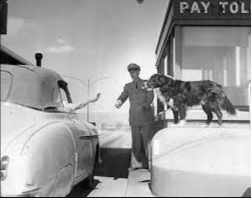
When construction finally wrapped up, many might have assumed Shep would move on.
Instead, he simply found a new group of friends.
The turnpike featured a toll plaza located between Denver and Boulder.
In the days before electronic toll systems, attendants worked long shifts collecting payments from drivers traveling in both directions.
When the construction crews left, they made sure the toll booth operators knew about their beloved canine companion.
The transition was seamless.
The toll collectors welcomed Shep, fed him, and soon considered him part of the team.
One chilly evening, an attendant even convinced him to sleep inside the booth rather than out in the Colorado cold.
From that point forward, the toll plaza became Shep’s home.
As the years passed, Shep became much more than a toll booth mascot.
Regular commuters began noticing him during their daily drives.
Families traveling the highway looked forward to seeing the friendly dog waiting near the toll station. Some drivers brought treats.
Others tossed a few extra coins into donation buckets set up to help pay for his food and care.
Soon, Shep wasn’t just known by toll workers.
He was known by everyone.
Children begged their parents to stop so they could take photos with him.
Travelers planned their trips around the chance to see Colorado’s most famous roadside dog.
For countless motorists, a brief encounter with Shep became the highlight of their drive.
Despite all the attention, Shep never lost his independent streak.
Like many strays, he loved to roam. During the day he often explored nearby fields and farmland before eventually returning to his post.
The toll attendants sometimes worried when he disappeared for hours at a time, but somehow he always found his way back.
One frightening incident nearly changed everything.
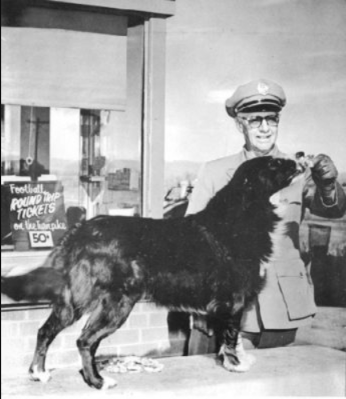
In 1958, Shep returned from one of his adventures limping badly. Someone had shot him in the front leg.
Thankfully, a local veterinarian stepped in and treated the injury at no charge.
Shep recovered and eventually returned to his familiar routine, greeting friends old and new along the turnpike.
But time catches up with every dog.
By the early 1960s, age had begun to take its toll. Shep’s hearing and eyesight declined, and his mobility became increasingly limited.
The dog who had once wandered freely through fields and construction sites now needed help simply getting in and out of the toll booth.
In 1964, those who loved him were forced to make a heartbreaking decision.
After years of companionship, laughter, and loyalty, it was time to say goodbye.
The community made sure Shep received a farewell worthy of the life he had lived.
He was buried near the turnpike he had called home for so many years. His gravestone carried a simple but unforgettable inscription:
“Part Shepherd. Mostly Affection.”
Even after his passing, people refused to forget him.
When highway improvements years later threatened his burial site, local residents rallied to preserve his memory.
His grave was carefully relocated to a safer location, ensuring future generations could continue visiting the dog who had become a symbol of friendship, loyalty, and community spirit.
Today, Shep’s story remains one of Colorado’s most beloved dog legends.
He never belonged to one family.
He belonged to everyone.
And perhaps that’s why people still remember him.
Because sometimes the dogs who leave the biggest paw prints aren’t the ones with famous owners or extraordinary abilities.
Sometimes they’re simply the dogs who show up, make people smile, and spend their lives reminding us how much joy can come from unconditional affection.