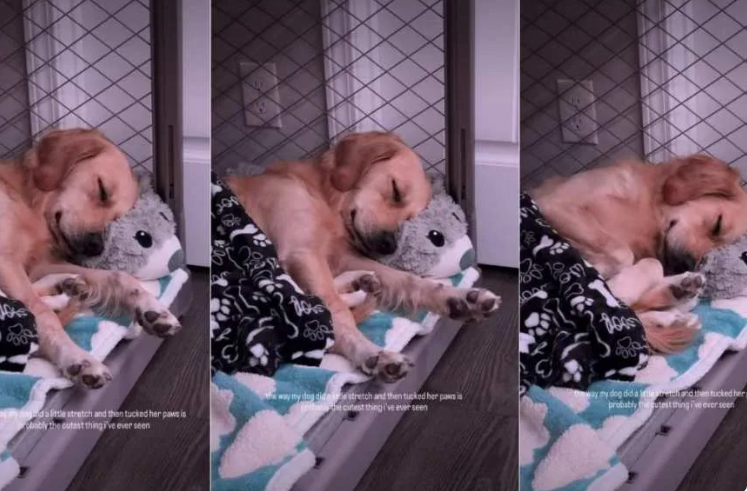
If you’ve ever watched your dog settle down for a nap, you’ve probably seen it.
That strange little routine.
The stretch forward… then the quick tuck into a tight curl.
It looks almost like a ritual—part yoga pose, part bedtime shuffle, part “I must get this just right before I commit to sleep.”
And as it turns out, it’s not random at all.
This behavior, often called the “stretch and tuck” or a variation of the classic “play bow into rest” transition, is something many dogs do as they move from activity into relaxation.
It’s a small but meaningful part of how dogs physically and mentally shift into rest mode.
First comes the stretch.
Front legs extended forward, chest lowered, back end still raised.
It’s the same posture many dogs use when they wake up or loosen stiff muscles after activity.
That stretch helps reset their body—loosening joints, engaging muscles, and preparing them to shift positions comfortably.
Then comes the tuck.
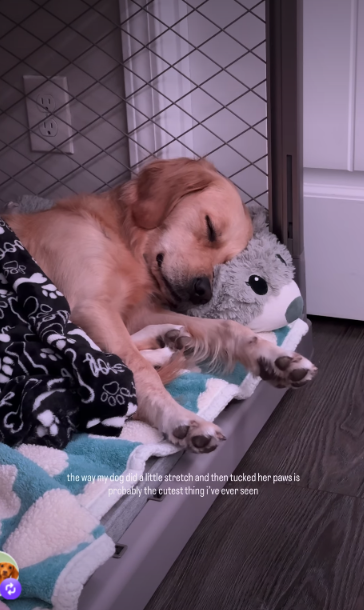
A quick repositioning where the dog pulls itself into a tighter, more secure resting shape—usually curled on its side or chest, sometimes with paws tucked neatly underneath.
It might look quirky from the outside, but for dogs, it serves multiple purposes.
Comfort is one.
Temperature regulation is another.
But there’s also something instinctive about it.
In the wild, dogs (and their ancestors) would often curl into tighter positions to protect vital areas of the body while resting.
Even in modern homes, that instinct hasn’t disappeared.
The “tuck” position offers a sense of security, even when there’s no actual threat present.
And the stretch beforehand helps signal a transition.
From movement to rest.
From alertness to calm.
It’s a small behavioral cue that the body is switching states.
Dog owners often notice this routine happening right before naps, bedtime, or even after bursts of play.
Sometimes it’s slow and exaggerated. Other times it’s quick and almost unconscious.
But it almost always follows the same pattern.
What makes it especially interesting is how consistent it is across different dogs, regardless of breed, size, or personality.
Whether it’s a high-energy retriever or a sleepy senior dog, many still perform this exact sequence before settling down.
Behavior experts often point out that routines like this are part of how dogs regulate themselves emotionally as well.
Predictable physical habits can help reduce stress and signal safety, especially in environments where they feel secure and comfortable.
So while it might look like just a cute quirk, it’s actually a small window into how dogs experience their world.
A stretch to reset.
A tuck to settle.
And a quiet moment where everything feels just right.
It’s one of those everyday behaviors that’s easy to overlook—but once you notice it, you start seeing it everywhere.
Right before the nap.
Right before the deep sleep.
Right before a dog fully lets the world fade out for a while.