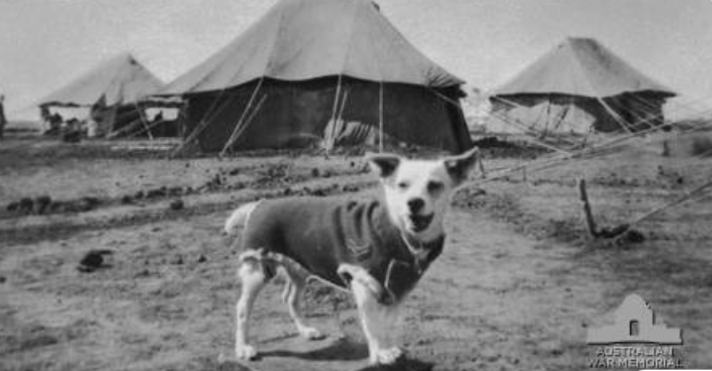
In the middle of World War II, surrounded by dust, gunfire, and chaos in the Middle East, Australian soldiers found comfort in something completely unexpected:
A tiny white puppy.
No medals.
No rank.
Just a scruffy little terrier mix wandering through the desert.
But before long, that dog would become one of the most beloved mascots in Australian military history.
His name was Horrie.
And soldiers loved him so deeply that some risked everything to keep him alive.
According to records preserved by the Australian War Memorial, Horrie was discovered in Egypt during the war by Private Jim Moody of the 2/1st Machine Gun Battalion.
The little white Egyptian terrier cross puppy was found near the Western Desert and quickly adopted by the battalion.
At first, he was simply a morale boost.
But Horrie quickly became much more than that.
The soldiers gave him his own uniform.
His own service number.
Even his own honorary military rank: Corporal.
And in the brutal environment of wartime, the tiny dog somehow became a symbol of comfort, routine, and home.
Men who faced constant danger suddenly had something innocent to protect.
Something alive and joyful in the middle of destruction.
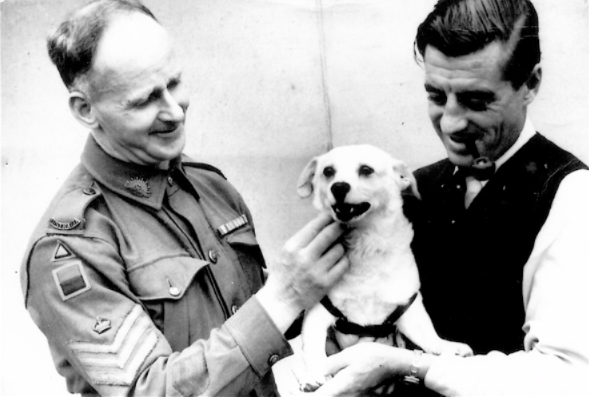
Horrie marched alongside troops during route marches. He attended parades with commanding officers.
Soldiers fed him scraps, carried him through dangerous areas, and treated him like one of their own.
But what made Horrie unforgettable wasn’t just his charm.
It was his courage.
During the war, soldiers reportedly discovered that Horrie’s hearing was incredibly sharp.
He could sense approaching German aircraft before many men realized danger was near. The troops began relying on his reactions as early warnings during air raids.
And that was only the beginning.
When the battalion moved into Greece, Horrie secretly traveled hidden inside Jim Moody’s kitbag.
Later, during evacuations and fighting in Crete, the little dog survived terrifying situations that easily could have killed him.
At one point, the ship carrying troops — the Costa Rica — sank during evacuation efforts.
Horrie survived.
Barely.
According to military records, he narrowly escaped being crushed between lifeboats during the chaos.
Even afterward, he kept working alongside the soldiers.
On Crete, Horrie reportedly became a messenger dog.
Troops tied handkerchiefs carrying written messages around his neck, and the dog would run through dangerous areas to deliver communications between patrols and soldiers hiding in olive groves.
Somehow, the tiny desert puppy had become part of the war effort itself.
But the hardships continued.
During the evacuation from Crete, Horrie was wounded by shrapnel.
Later, while stationed in Palestine during harsh winter weather, soldiers made him a special coat to help him survive freezing temperatures and snow.
And through every battle, every relocation, every terrifying moment…
The soldiers refused to leave him behind.
That decision would eventually change everything.
In 1942, when Australian troops prepared to return home, strict quarantine laws made it illegal to bring foreign animals into Australia because of fears surrounding rabies and disease.
Other mascots discovered onboard ships were reportedly destroyed immediately under quarantine regulations.
But Jim Moody couldn’t accept that fate for Horrie.
So he made a dangerous choice.
He secretly smuggled the dog back into Australia.
According to historical accounts, Moody modified his military pack so Horrie could hide inside quietly during the voyage home.
Soldiers helped conceal the dog throughout the trip, protecting him constantly from discovery.
For a while, it worked.
Horrie survived the war.
He lived quietly while Moody continued serving.
But everything unraveled after a book about Horrie’s wartime adventures gained publicity in 1945. The story attracted national attention — and eventually reached Australian quarantine authorities.
Suddenly, the beloved war dog faced execution.
Officials argued that quarantine laws had to be enforced strictly to protect Australia from rabies.
Even though internal correspondence later acknowledged Horrie no longer posed a rabies risk after spending years in Australia, authorities still pushed for the dog to be destroyed as an example to discourage future smuggling.
Public reaction was explosive.
Many Australians were horrified that a dog who survived war beside soldiers would now be put down by his own country.
Letters poured in.
People begged officials to spare him.
But according to official records, Horrie was surrendered to quarantine authorities in March 1945 and was euthanized days later.
At least… officially.
Because decades later, another story emerged.
According to members of Jim Moody’s family and former soldiers, Moody may have secretly switched Horrie with a lookalike dog from a pound before surrendering him to authorities.
The theory claims the “real” Horrie escaped execution and quietly lived out the rest of his life in rural Victoria.
Nobody knows for certain which version is true.
But perhaps that mystery became part of Horrie’s legend too.
Because to the soldiers who loved him, Horrie was never “just a dog.”
He represented loyalty during chaos.
Comfort during fear.
And the strange, powerful way animals help humans survive the darkest chapters of life.
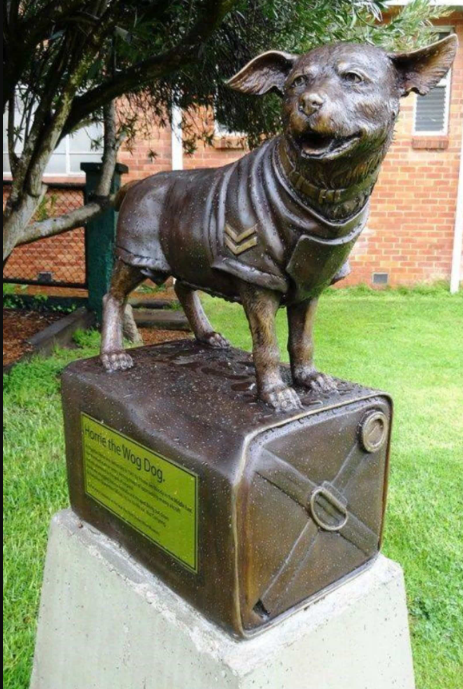
Long after the war ended, people continued laying wreaths in Horrie’s memory on Anzac Day.
Not because he was famous.
But because somewhere in the middle of war, a tiny white dog reminded exhausted soldiers what love, loyalty, and home still felt like.