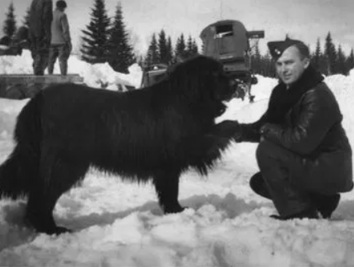
Before he became a war hero, he was just a playful family dog named Pal.
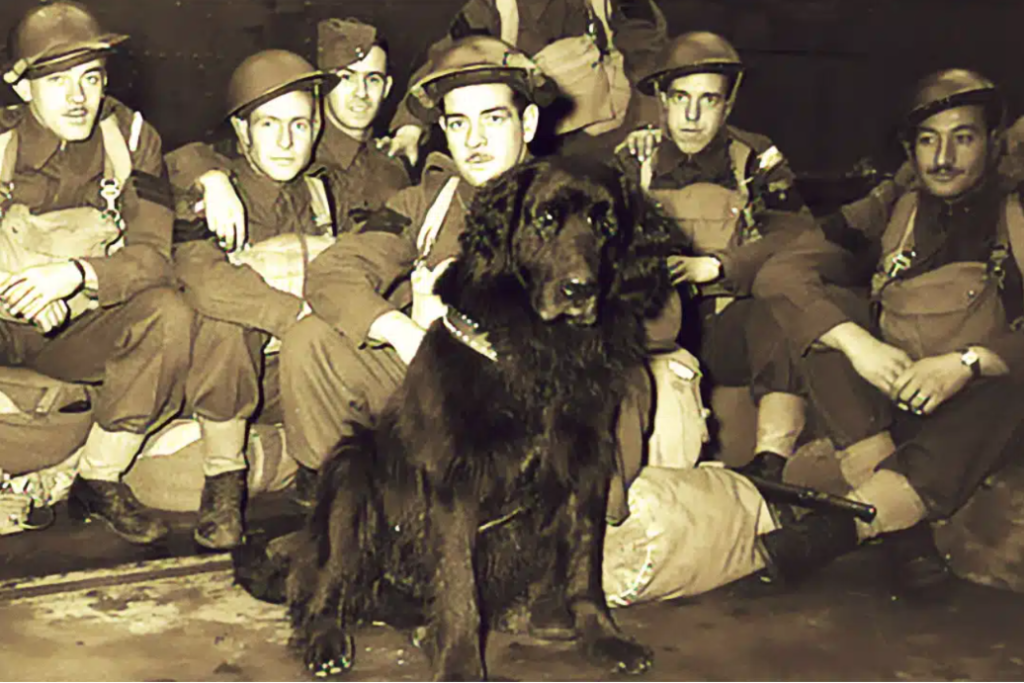
A massive black Newfoundland with oversized paws, endless energy, and a habit of barreling through life like nothing could ever hurt him.
Children adored him.
He pulled sleds through snowy streets in Newfoundland, chased after planes near the local airfield, and followed people everywhere with the kind of joyful loyalty only dogs seem capable of giving.
But one accident changed everything.
During rough play, Pal accidentally scratched a young girl badly enough to require medical attention.
His family feared the incident could lead to him being euthanized, so instead, they made a heartbreaking decision:
They gave him to a Canadian Army regiment stationed nearby.
That regiment was the Royal Rifles of Canada.
And that’s where Pal became Gander.
The soldiers renamed him after the town where they were stationed and quickly adopted him as one of their own. Not just a mascot. Not just a pet.
A brother.
The troops even “promoted” him to sergeant, complete with a collar bearing his rank.
He received rations, slept among the soldiers, and reportedly hated being separated from the men so much that they eventually allowed him inside the barracks permanently.
For the young soldiers preparing for war, Gander became comfort in uncertain times.
A giant furry reminder of home.
Then came 1941.
The Royal Rifles were sent to Hong Kong as tensions escalated during World War II. The men boarded the ship knowing they were sailing into danger.
And somehow, Gander went too.
No one wanted to leave him behind.
That alone says everything about how much the soldiers loved him.
When Japanese forces invaded Hong Kong in December 1941, the battle quickly became brutal.
The Canadians were heavily outnumbered, exhausted, and trapped in chaotic fighting that often stretched through the night.
And right in the middle of it all was a 130-pound Newfoundland dog.
Stories from surviving soldiers describe Gander charging enemy troops during nighttime attacks, barking, lunging, and creating enough confusion to disrupt advances.
Some accounts say Japanese soldiers referred to him as a terrifying “black beast” appearing suddenly in the darkness.
Imagine the scene.
Gunfire.
Smoke.
Explosions.
And through all of it, this enormous black dog refusing to abandon his men.
But the moment that would make Sergeant Gander legendary came during one horrifying instant on December 19, 1941.
Several wounded Canadian soldiers lay grouped together during intense fighting near Lye Mun. They were injured, vulnerable, and unable to move quickly.
Then a grenade landed among them.
There wasn’t enough time.
The soldiers couldn’t escape.
Death was seconds away.
And then Gander moved.
According to military accounts, the Newfoundland rushed toward the grenade, grabbed it, and ran away from the wounded men toward enemy lines.
The explosion killed him instantly — but saved the soldiers behind him.
Even decades later, people still debate whether Gander understood the danger or simply reacted instinctively.
Reddit discussions about his story often circle around the same emotional conclusion:
Whatever the reason, he saved lives.
And perhaps that’s what matters most.
Because dogs don’t calculate heroism the way humans do.
They protect the people they love.
That’s it.
Simple.
Pure.
Absolute.
For years after the war, Gander’s story survived mostly through veterans who refused to let him be forgotten.
Survivors fought for recognition, insisting that the dog who died beside them deserved to be remembered alongside soldiers.
Finally, in 2000 — nearly 60 years after his death — Sergeant Gander was posthumously awarded the Dickin Medal, often called the animal equivalent of the Victoria Cross.
It was the first such award given in over half a century.
His name now appears on the Hong Kong Veterans Memorial Wall alongside fallen Canadian service members.
That detail alone feels almost overwhelming.
A dog.
Listed among soldiers.
Not because people were sentimental.
Because the men who survived believed he earned it.
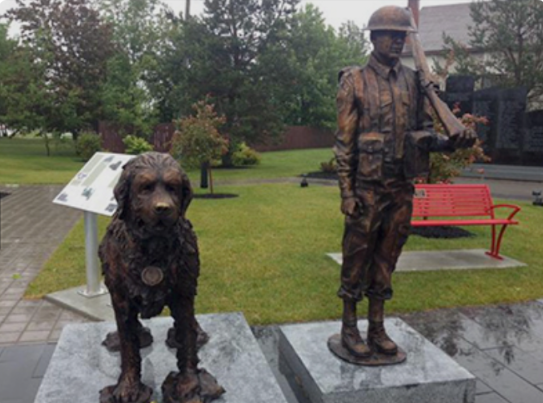
Today, statues and memorials honor Sergeant Gander in Canada, where his story continues to inspire generations who never met him.
And maybe that’s because his story reminds us of something easy to forget:
Courage doesn’t always wear a uniform.
Sometimes it has four paws.
Sometimes it drools.
Sometimes it chases planes and sleeps beside frightened young soldiers far from home.
And sometimes, in the worst moment imaginable, it runs toward danger so others can live.
Sergeant Gander never came home from war.
But the men he saved did.
And for them, that giant black dog was never “just a dog.”