War stories are usually told through soldiers, generals, and battlefields.
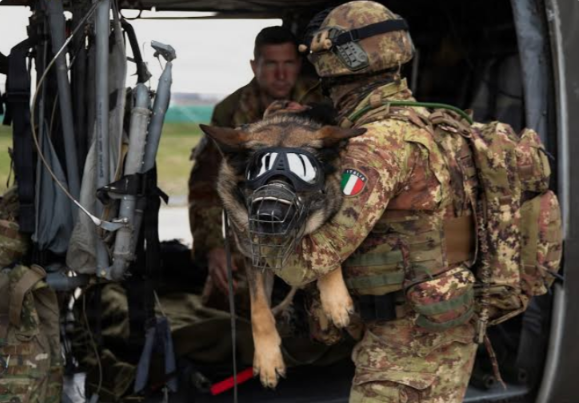
But tucked inside the history of World War II is a lesser-known chapter that sounds almost unbelievable at first: animals trained to parachute out of aircraft, dropping into danger alongside human forces, and helping shape military operations in ways few people expected.
They weren’t there for spectacle.
They were there for survival, support, and strategy.
And in some cases, they changed the outcome of missions in ways that only became fully appreciated later.
During the war, military planners were constantly searching for ways to improve communication, reconnaissance, and battlefield efficiency.
Traditional methods had limits, especially in environments where sending humans first was too risky or impractical.
That challenge led to experimentation—some of it unusual, even by wartime standards.
Among those experiments was the idea of training dogs to parachute.
At first glance, it sounds almost impossible. Dogs are not natural skydivers.
The noise, altitude, and sudden drop from an aircraft would be overwhelming for most animals.
But military trainers discovered something important: dogs are highly adaptable, especially when trained gradually and conditioned with structure and reward.
The concept wasn’t random.
Dogs were already deeply embedded in military work by that time—used for messaging, scouting, guarding, and detecting hazards.
Expanding their role into airborne operations was an extension of their existing value on the ground.
Training began carefully.
Dogs were introduced to harnesses designed to keep them secure during descent.
They were slowly acclimated to elevated platforms, then to mock drops, and eventually to real parachute jumps from aircraft under controlled conditions.
The goal was not speed—it was trust. The animals had to learn that the harness, the motion, and the descent were safe.
That conditioning process mattered more than anything else.
Because once deployed, these dogs were expected to land in unfamiliar or hostile terrain and immediately continue working.
Their missions varied depending on operational needs.
In some cases, they were used to help locate injured soldiers or deliver messages across difficult terrain.
In others, they assisted with reconnaissance tasks, leveraging their senses in environments where visibility or communication lines were compromised.
What made them especially valuable was not just their training—but their instincts.
Dogs can detect movement, scent, and human presence with a sensitivity that far exceeds human capability.
In chaotic battlefield environments, those abilities became strategic tools.
Once deployed from the air, these canine paratroopers would land and quickly transition from descent to mission mode.
Handlers on the ground would coordinate retrieval and guide them into active roles.
The success of these operations depended heavily on preparation—both for the animals and the humans working alongside them.
Of course, not every experiment in wartime innovation became a permanent practice.
The use of animal paratroopers remained limited and highly specialized.
It reflected a period of intense experimentation, where military necessity often pushed boundaries in unexpected directions.
But even as a niche strategy, it left a lasting impression.
It demonstrated just how deeply humans were willing to integrate animals into complex systems of warfare—not just as support on the ground, but as active participants in high-risk operations.
And it raises questions that still resonate today about training, ethics, and the roles animals are asked to play in human conflicts.
For many, the idea of dogs parachuting from aircraft feels surreal.
But within the context of wartime urgency, it was treated as a practical solution to very real challenges.
These animals were not seen as symbols.
They were seen as partners in function—trusted, trained, and deployed with specific objectives in mind.
And while modern military practices have evolved significantly since then, the legacy of these early experiments remains a striking reminder of how far innovation can go in times of crisis.
It also highlights something more enduring: the extraordinary adaptability of dogs themselves.
Whether on the ground, in search roles, or—even briefly—in the sky, they responded to human direction with remarkable consistency.
They learned new environments. They adapted to fear-inducing conditions. And they carried out tasks that, at first glance, seemed beyond their nature.
In the end, the story of these “furry paratroopers” is not just about military history.
It’s about trust under pressure.
It’s about the lengths humans will go to solve impossible problems.
And it’s about the animals who, willingly or not, became part of that effort—leaving behind a quiet but unforgettable footprint in the story of WWII.