It started as an ordinary walk in the park.
Leash. Grass. Routine distractions.
And then everything paused.
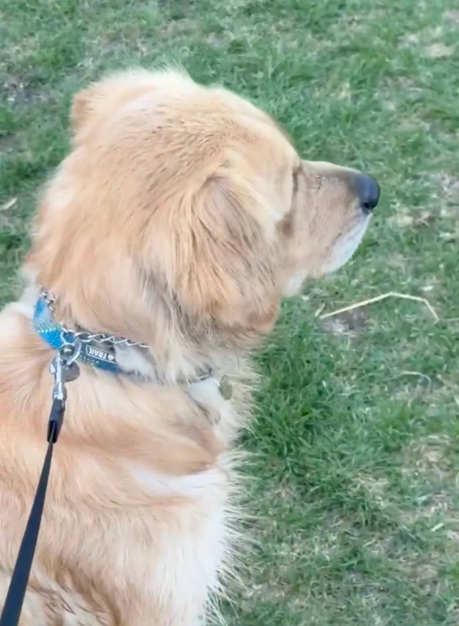
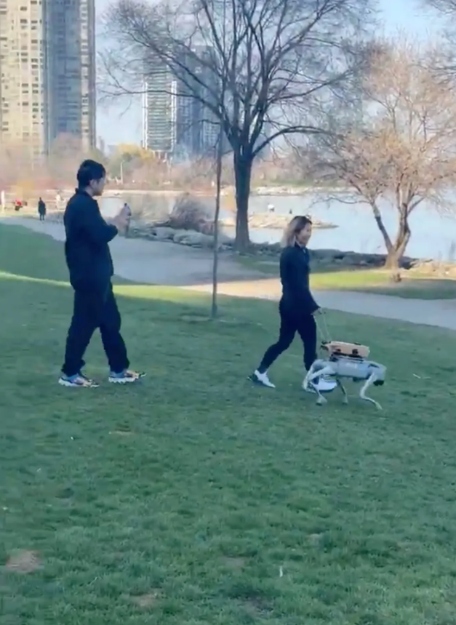
A Golden Retriever suddenly stopped mid-step when something unusual came into view: another “dog” walking nearby — but not quite like any dog he had ever seen before.
It was a robotic dog.
Leashed. Moving. Mechanical. Precise.
And for a moment, the Golden Retriever didn’t know what to do with that information.
He froze completely.
Not barking.
Not pulling.
Just staring.
The kind of stillness that happens when instinct tries — and fails — to categorize what it’s seeing.
In the video, his owner continues walking slightly ahead while the dog remains locked in place, eyes fixed on the robotic canine as it passes by.
The moment feels almost like a system processing error — curiosity, confusion, and suspicion all competing at once.
This wasn’t aggression.
It wasn’t fear.
It was pure cognitive overload.
A “what am I looking at?” moment in real time.
As the robot dog continues down the path on its leash, the Golden Retriever finally starts to move again, but not with his usual confidence.
Instead, he leans forward, tracking it carefully, trying to understand whether this thing belongs in the category of “dog” at all.
Eventually, curiosity wins.
He starts to follow.
Slowly at first.
Still watching.
Still processing.
Robotic dogs like the one in the clip are part of a growing category of autonomous machines designed to mimic animal movement using sensors, motors, and AI-based control systems.
These machines are increasingly realistic in how they walk and respond, often blurring the line between biological and artificial motion.
That blurring is exactly what makes encounters like this so visually striking.
Dogs rely heavily on scent, movement patterns, and social cues to identify other animals.
When something looks like a dog but lacks familiar biological signals, it can create a brief breakdown in recognition — leading to hesitation, fixation, or cautious investigation.
Which is exactly what played out here.
The Golden Retriever wasn’t just reacting to a novelty.
He was trying to solve a puzzle his instincts weren’t built for.
And the humor of the moment comes from that mismatch.
On one side: a living dog, wired for emotion and social reading.
On the other: a machine designed to imitate enough of those signals to be convincing — but not quite enough to be fully understood.
The result is a stare-down that feels almost philosophical.
“Are you real?”
“Are you me?”
“Should I be worried?”
As the robot moves farther away, the dog briefly considers following more closely, then slows again — still unsure how seriously to take what he just witnessed.
And that lingering uncertainty is what makes the clip stick.
Not because anything dramatic happened.
But because for a few seconds, a Golden Retriever had to confront something his instincts didn’t have a ready answer for.
A dog-shaped question mark walking down the park path.