Most optometry students spend their days buried in textbooks, lectures, and clinical work.
Luke Pellegrino does all of that too.
But when classes end, his responsibilities don’t.
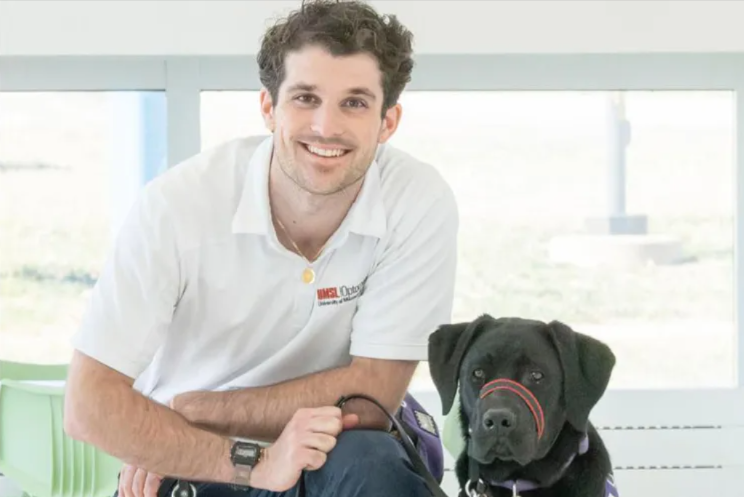
Because waiting beside him is Maverick—a future guide dog in training.
Pellegrino, 25, is currently in his second year at the University of Missouri–St. Louis (UMSL), where he’s pursuing a future in optometry with a special focus on low vision care.
His passion for helping visually impaired people began years earlier during a summer job at Dream Oaks Camp in Florida, where he worked with children facing various medical conditions, including low vision.
While he had already worked in optometry before, something about that experience stayed with him.
“I really enjoyed working with the kids with low vision,” he explained. “That’s where my passion really developed.”
During one camp session, a conversation with a camper’s mother introduced him to the world of guide dogs.
She shared that she hoped her son would one day have a guide dog of his own, and she told Pellegrino about Dogs Inc., an organization that trains guide and service dogs for people with visual impairments, veterans, diabetics, first responders, and more.
The idea stuck.
So after beginning optometry school, Pellegrino decided he wanted to become part of that mission in a hands-on way.
“School is stressful,” he said. “Dogs can also make that much better too.”
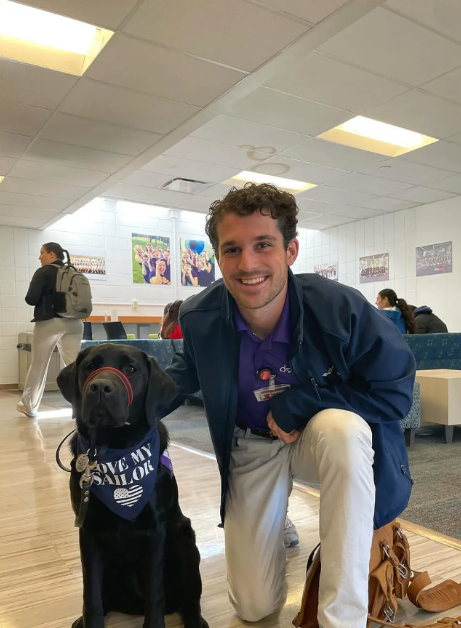
Through Dogs Inc., Pellegrino was connected with a volunteer puppy raiser named Lori in Texas, who helps care for puppies during their earliest weeks.
She first raised a puppy named Electra before Pellegrino took over her training at around 6 months old.
Eventually, Electra moved on to advanced formal training, and Pellegrino began raising his second guide dog prospect: Maverick.
Now, the two are nearly inseparable.
Every day starts early. Around 6 a.m., Pellegrino and Maverick head outside before beginning a packed schedule filled with classes, clinics, labs, and study sessions.
By 8 a.m., Maverick is riding the train with him to campus, where he spends the day learning how to navigate busy public spaces calmly and confidently.
And that training happens everywhere.
On campus, Maverick socializes with students, practices staying calm around distractions, and spends time in outdoor courtyards between classes.
During clinical rotations, he accompanies Pellegrino into real patient-care environments, learning how to behave around medical equipment, canes, mobility tools, and unfamiliar people.
For guide dogs, experiences like these are critical.
Before they can someday guide a visually impaired person safely through the world, they first need to learn how to move confidently through unpredictable environments themselves.
That’s where puppy raisers play such an important role.
Dogs Inc. provides guidance throughout the process, assigning advisors who regularly check in with training support, milestone tracking, and video consultations to help volunteers succeed.
And the work matters.
Electra, the puppy Pellegrino previously raised, is now officially in the guide dog program preparing for placement with a visually impaired person.
“I’m so proud of her,” he said.
Still, raising guide dogs comes with an emotional challenge most people underestimate.
Eventually, the dogs leave.
Pellegrino spends nearly every hour of every day with these puppies—training them, traveling with them, studying beside them, and building an intense bond through routine and trust.
Letting them move on to formal training is never easy.
“There is no stronger connection,” he explained. “You build such a strong bond, and letting them go is so hard.”
But he also understands the bigger picture.
These dogs are being prepared for lives that will change someone else’s future forever.
Guide dogs offer far more than mobility assistance.
They restore independence, confidence, and emotional security for people navigating visual impairment.
And Pellegrino believes more people—especially future optometrists—should become involved in that process.
“There’s a misconception that there aren’t options for people who are visually impaired,” he said. “Guide dogs can give confidence back.”
Today, while balancing exams, patients, clinics, and long academic days, Pellegrino continues helping shape future guide dogs one routine at a time.
And somewhere down the road, a visually impaired person will eventually meet one of those dogs and gain something life-changing:
Not just assistance.
But freedom, confidence, and companionship—built step by step by a student who decided to dedicate his education to helping people see the world more clearly in every possible way.