
Dogs don’t announce stress the way humans do.
They don’t explain it, talk it through, or walk away from overwhelming situations.
Instead, they communicate it quietly—through posture, movement, and small behavioral shifts that are easy to miss if you’re not looking closely.
And that’s where misunderstandings begin.
What looks like “bad behavior” is often something else entirely: a dog trying to cope with discomfort, uncertainty, or fear.
Stress in dogs can show up in both obvious and subtle ways.
Some signals are physical—panting when it’s not hot, trembling without cold, or pacing restlessly around a room.
Others are more nuanced and tied to body language: ears pinned back, tail tucked, stiff posture, or a noticeable avoidance of eye contact.
These are often early indicators that a dog is feeling unsafe or overwhelmed rather than simply being disobedient.
One of the most common early signals is also one of the easiest to misread: the yawn.
A yawn doesn’t always mean tiredness. In stressful contexts—during training, vet visits, or unfamiliar environments—it can function as a calming behavior, a way for dogs to self-soothe when they feel pressure.
Lip licking and repeated nose licking often fall into the same category, acting as subtle communication that a dog is uneasy but trying to stay composed.
Then there are the changes in movement and behavior that tend to escalate when stress builds.
A dog might begin pacing without settling, circling the same area repeatedly, or shifting constantly from one spot to another.
Some dogs become overly vocal, barking or whining more than usual, especially when separated from their owners.
Others go in the opposite direction and withdraw—hiding under furniture, avoiding interaction, or showing a sudden lack of interest in people or play.
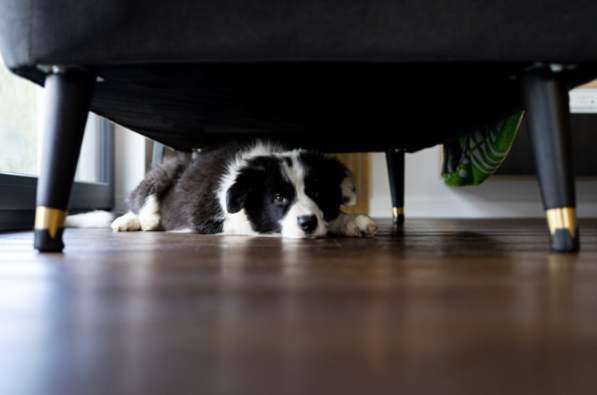
In more intense cases, stress can spill over into behavior that gets labeled as “problematic.”
Destructive chewing, digging, or even house soiling in previously trained dogs can all be responses to emotional overload.
These aren’t random acts—they are often coping mechanisms for anxiety, especially when a dog feels trapped in a situation they don’t understand or cannot escape.
Body language plays a critical role in reading what a dog is experiencing internally.
A lowered body posture, stiffened muscles, or a tucked tail can indicate fear or insecurity.
Some dogs may show “whale eye”—where the whites of their eyes become visible—as they try to track threats while avoiding direct confrontation.
Others may freeze entirely, holding still as a defensive response to stress.
Importantly, stress is not always triggered by dramatic events.
It can come from everyday changes: a shift in routine, unfamiliar visitors, loud noises, or even subtle environmental tension.
Dogs are highly sensitive to predictability, and disruption in their normal rhythm can accumulate into anxiety over time.
What matters most is recognizing that these signals are not random.
They form a language—one built from repetition, instinct, and survival behavior.
When a dog yawns in a tense situation, avoids interaction, or begins pacing, they are not being difficult.
They are communicating discomfort in the only way they can.
Responding correctly doesn’t require complex intervention.

In many cases, it starts with observation and adjustment: reducing exposure to stress triggers, restoring routine, giving space when needed, and allowing the dog to decompress without pressure.
For more persistent or severe cases, professional behavioral support may be necessary, especially when anxiety begins affecting daily functioning.
There is also an important underlying layer often overlooked: emotional feedback between humans and dogs.
Dogs are highly attuned to human emotional states.
Stress, tension, and inconsistency from owners can influence canine behavior, creating a feedback loop where both sides become more anxious without realizing it.
That makes awareness even more important.
Because once you can recognize stress signals early, you don’t just correct behavior—you prevent escalation.
You give your dog the chance to reset before discomfort turns into chronic anxiety.
And in the end, that’s what these signals are really asking for.
Not punishment.
Not correction.
Just understanding.