There’s a special kind of joy that comes with watching a rescue dog fully settle into a life of love and comfort. For Ryder, a sweet Shar‑Pei mix with expressive ears and huge, hopeful eyes, that joy comes with a sound most unexpected — adorable donkey‑like noises he makes while signaling it’s time to be tucked in for the night.
Ryder’s story isn’t just about a funny quirk — it’s about trust, routine, and the kind of relationship that blossoms when a dog knows they finally belong somewhere safe.
After spending about two years in a shelter, Ryder eventually found his forever family. Like many shelter dogs, those early months were filled with uncertainty, waiting for the right people to come along. But once Ryder’s new family welcomed him into their home, everything changed.
Adopted dogs often reveal little pieces of their personality as they settle into a stable life, but Ryder’s particular expression of affection stands out.
Rather than simply leaning in or pawing at his person to be tucked under the blankets, he makes a soft, donkey‑like bray — a unique vocalization that melts hearts and makes anyone watching smile. It’s not a bark, growl, or whine — it’s a distinct sound that echoes innocence, routine, and a dog who feels utterly comfortable asking for what he wants.
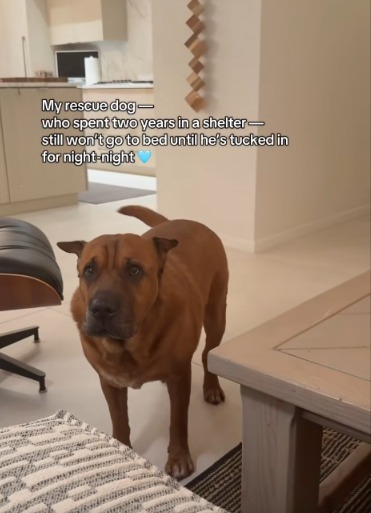
His daily bedtime ritual has become a cherished tradition in his home.
Mom explains that as the evening winds down, Ryder lets her know it’s tuck‑in time with his signature “donkey noises,” followed by a little nudge, a look, and that soft sound that seems to say, “I’m ready for my cozy spot now.”
It’s become a moment of connection — a way Ryder communicates his desire for comfort and closeness before settling into sleep.
People who’ve seen videos of Ryder’s nighttime routine online often react with laughter and affection. What’s clear from the reactions is that his unusual vocalization isn’t just cute — it’s relatable.
Many dog lovers recognize how pets develop quirks that reflect their personalities and the ways they bond with their humans. Whether it’s a unique greeting, a specific way of demanding snacks, or in Ryder’s case, nightly donkey‑like sounds, those behaviors become part of what makes a dog unmistakably themselves.
More importantly, Ryder’s story highlights something deeply meaningful about rescue dogs in general. When a dog spends a long time in a shelter, it takes patience, consistency, and a lot of love for them to unpack their true selves.
Security isn’t given at the shelter — it’s earned over time in a stable home. And when that trust finally forms, dogs like Ryder start to show parts of themselves that are fully unguarded — joyful, quirky, and heart‑melting.
The special bond between Ryder and his family shines through in every moment of his bedtime routine. He’s not just signaling he’s sleepy — he’s expressing trust and a desire for affection before drifting off.
And while the donkey‑like noises may be what first catches viewers’ attention, the real story is about love, trust, and the little ways dogs communicate what they need most.
For anyone who’s ever welcomed a rescue dog into their life, Ryder’s nightly serenade is a reminder of how beautifully unique every adoption story can be.
It’s also a gentle nudge to look — truly look — at the ways dogs choose to interact with us once they feel safe enough to show their whole selves.
In the end, Ryder doesn’t just make adorable noises — he shares them as a form of love and connection, turning an ordinary bedtime into something extraordinary.