When a pregnant shelter dog was brought in for an X-ray, the veterinary team expected a fairly routine moment.
A quick scan. A simple count. A plan for delivery.
But what appeared on the screen made everyone pause.
Something wasn’t adding up.
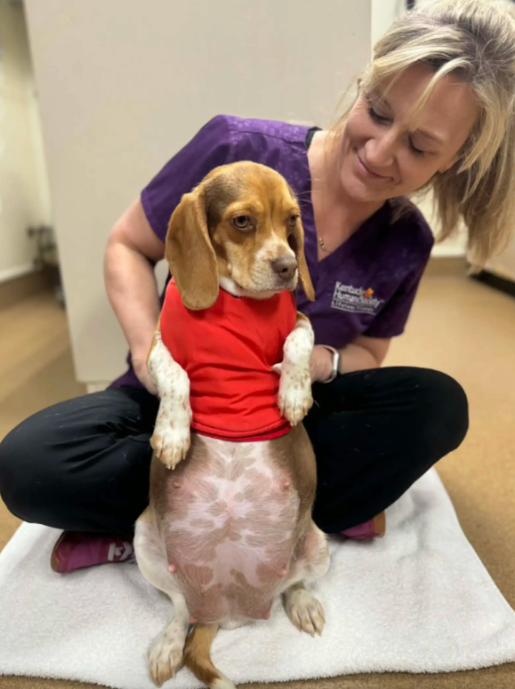
The dog—small, underweight, and clearly nearing the end of her pregnancy—was carrying puppies that looked… unexpected.
Not in number.
But in size.
The veterinarians expected a typical litter for a dog her build, likely small and evenly sized.
Instead, the imaging revealed that the puppies were noticeably larger than anticipated, creating immediate concern about how safely she would be able to deliver them.
Because in situations like this, size matters.
Bigger puppies can mean complications during birth, especially for a young or physically compromised mother.
And this dog had already come from a difficult start—arriving at the shelter in poor condition and clearly needing extra care.
So the team shifted from observation to preparation.
This wasn’t going to be a wait-and-see situation.
It was going to require planning.
Veterinarians monitored her closely, watching for signs that labor might begin at any moment. Everything about her condition suggested that intervention could become necessary.
And they were right.
When labor finally started, it became clear that a natural delivery might be too risky.
The puppies were simply too large relative to her size, and the stress on her body was increasing.
The veterinary team made the decision to proceed with an emergency C-section.
It was a fast, coordinated effort—exactly the kind of situation shelters and vet teams train for, but never hope to use.
Within minutes, the surgery was underway.
And soon after, the puppies were delivered safely.
All three of them.
Healthy.
Strong.
And far more substantial than anyone had originally expected.
Once they were born, the atmosphere shifted completely.
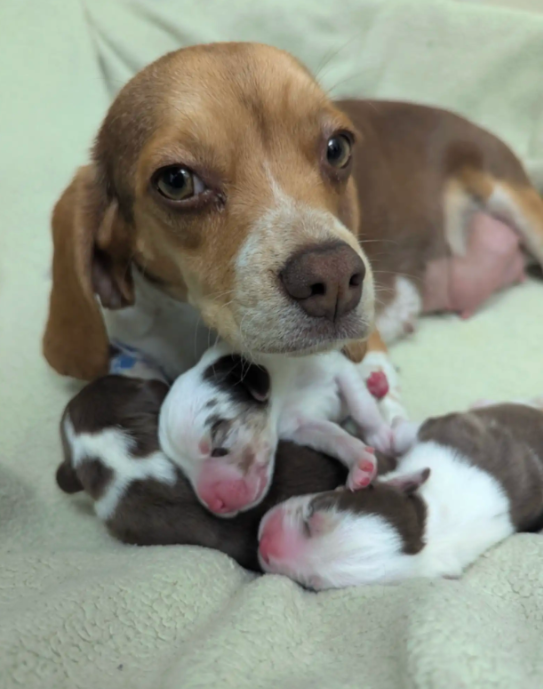
What had started as a tense medical situation turned into something softer—something hopeful. The mother dog, now safely recovering, quickly transitioned into care mode.
Despite everything she had just gone through, her focus shifted immediately to her puppies.
That instinct never fails to amaze veterinary staff. No matter how stressful the delivery, many mother dogs seem to recognize their role the moment it becomes possible.
She began caring for them gently, staying close, making sure they were warm and fed. The tension of the procedure faded, replaced by quiet, steady recovery.
And in the days that followed, something important became clear.
Against all early concerns, the puppies were thriving.
They were feeding well. Growing steadily.
And bonding closely with their mother, who seemed to settle into her role with surprising ease considering how difficult the delivery had been.
The shelter team stayed close during those first critical days, ensuring everything remained stable. What they saw was a family slowly finding its rhythm—one feeding, one nap, one quiet moment at a time.
Stories like this often begin with uncertainty. A difficult X-ray. A risky pregnancy. A set of unknowns that require careful medical judgment.
But they don’t always end in difficulty.
Sometimes, they end in relief.
A safe delivery.
A recovering mother.
Three puppies who, despite initial concerns, are simply growing as they should—curious, strong, and completely unaware of how close things came to being very different.
And for the veterinary team, it’s another reminder of why they do what they do.
Because behind every scan and every decision is a life waiting for the right outcome.
And sometimes, the surprise isn’t a problem at all.
It’s just the beginning of a story that turns out better than expected.