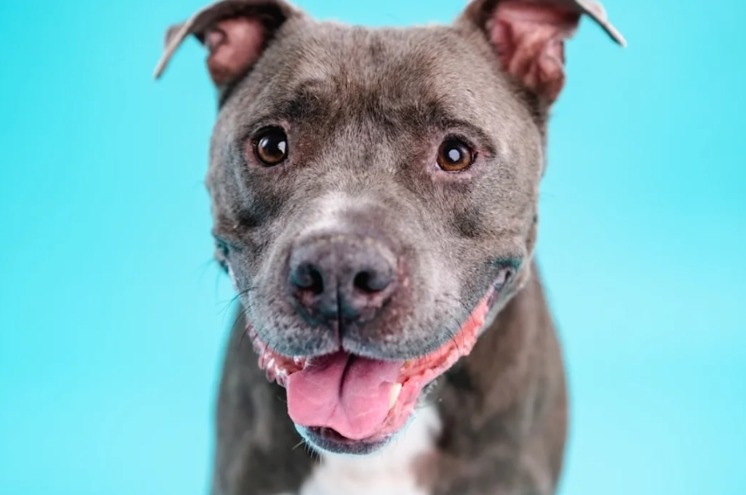
She had given birth more times than anyone bothered to count.
Litter after litter. Puppy after puppy.
Her body had done its job.
And when it couldn’t anymore — when she was no longer “useful” — she was thrown away.
Not rehomed with care. Not retired with gratitude.
Discarded.
When rescuers first found her, she didn’t look like a dog who had known comfort. Her body was thin, worn down from years of breeding. Her eyes carried a heaviness that didn’t match her gentle nature. She had likely spent most of her life confined — valued only for what she could produce.
No soft couch.
No long walks.
No one whispering her name with affection.
Just cycles.
And then, nothing.
Dogs from commercial breeding operations often arrive in rescue with more than physical scars. They’ve missed out on normal experiences — stairs, doorbells, grass beneath their feet. Everyday life can feel overwhelming when you’ve only known a cage.
At first, she was cautious.
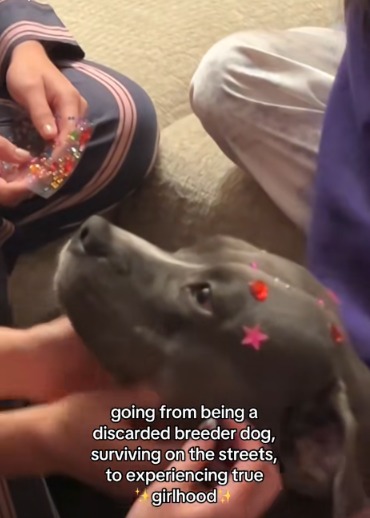
Every sound made her pause. Every open space seemed too big. She moved slowly, as if unsure she was allowed to take up room. When someone reached toward her, she flinched — not aggressively, just reflexively.
Not because she didn’t want love.
Because she didn’t know what it felt like.
But here’s what makes stories like hers so powerful:
Even after everything, she stayed soft.
No snapping. No bitterness. Just quiet uncertainty.
And beneath that uncertainty — hope.
Her foster family understood that healing wouldn’t happen overnight. They didn’t rush her. They didn’t overwhelm her with expectations. They gave her something she’d likely never had before:
Time.
The first time she stepped onto grass, she hesitated. Then she took one careful step. Then another. Her nose lowered. She sniffed. A breeze moved through her fur.
It was new.
And slowly, new became safe.
She discovered blankets. The way fabric feels when you knead it gently before lying down. She learned that couches are for resting, not avoiding. She began following her foster around the house — not closely at first, just enough to keep them in sight.
Then came the breakthrough moment.
One evening, as her foster sat on the floor, she approached. Carefully. Tentatively. And without prompting, she rested her head on their lap.
It wasn’t dramatic.
It wasn’t loud.
But it was everything.
Because that small gesture meant trust had begun to bloom.
Day by day, she grew braver. Her tail started wagging more freely. She discovered toys — at first confused by them, then delighted. A squeak startled her the first time. The second time, she leaned in.
She began to play.
Not because she had to.
Because she could.
The dog who had once been valued only for reproduction was now valued for herself — her quiet companionship, her sweet temperament, her gentle presence. She wasn’t a breeding machine.
She was someone’s dog.
And when her forever family found her, they didn’t see a discarded breeder.
They saw resilience.
They saw a soul who had survived neglect without losing her capacity for love.
They saw the way she leaned into affection once she felt safe. The way her eyes softened when someone spoke kindly to her. The way she stayed close, as if making up for years of isolation.
Today, she sleeps in a warm bed.
She eats from her own bowl.
She walks beside people who know her name — and say it with tenderness.
Her past isn’t erased. The years she spent confined still happened.
But they don’t define her.
What defines her is what she did next.
She trusted again.
She loved again.
And in doing so, she reminds us of something quietly extraordinary:
Even dogs who were used and discarded still believe in us.
They still wag their tails.
They still press their heads into our hands.
They still choose connection.
Not because we always deserve it.
But because loving is who they are.