If you’ve ever tried to keep your dog out of the kitchen, away from the couch, or safely inside your yard, you already know this: telling them “no” isn’t enough.
Dogs don’t naturally understand invisible rules. They need to be shown where the line is — and more importantly, why staying on the right side of that line is worth it.
That’s where boundary training comes in.
Boundary training is exactly what it sounds like: teaching your dog where they can and cannot go. Whether it’s a single room, a doorway, or your entire yard, the goal is to help your dog choose the correct behavior — not just obey when you’re watching.
And when it’s done right, it’s one of the most powerful tools you’ll ever use as a dog owner.
Let’s start with why this matters.
Boundaries aren’t just about convenience — they’re about safety and structure. A dog that understands limits is less likely to bolt out a door, wander into danger, or develop habits like counter-surfing or jumping on furniture.
But here’s the key: consistency is everything.
If your dog is allowed into the kitchen sometimes but not others, you’re not teaching a boundary — you’re creating confusion. Dogs learn through repetition and clarity. The rule has to be the same every time.

So how do you actually teach it?
It starts simple.
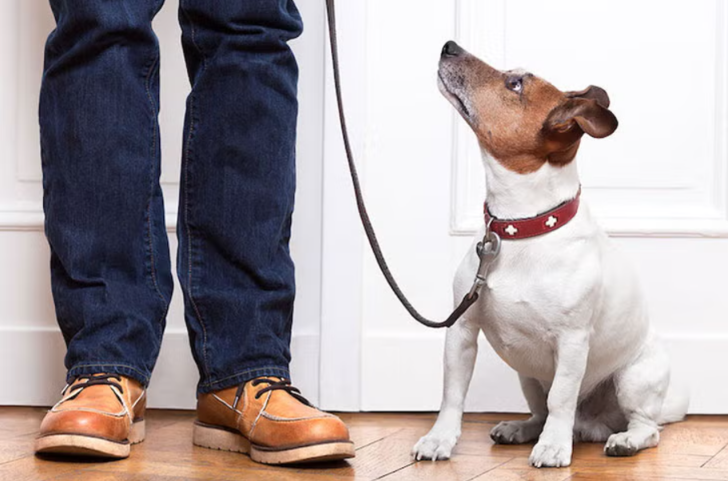
For indoor boundaries — like keeping your dog out of a room — begin with a leash and some high-value treats. Walk your dog toward the doorway and stop just before entering. When your dog stops with you, reward them immediately. Then turn around and walk away.
You’re teaching something subtle but powerful:
Stopping at the boundary = reward
Crossing it = nothing
Repeat this until your dog begins to pause on their own.
Once they understand that part, you increase the challenge.
Take a step into the room while your dog stays outside. If they try to follow, gently block them and reset. If they stay put, go back and reward them.
Over time, you’ll build three critical elements:
Distance (you move further away)
Duration (they wait longer)
Distraction (temptations increase)
These are often called the “three Ds” of training — and mastering them is what turns a basic skill into a reliable behavior.
Now here’s where most people go wrong.
They rush.
They expect the dog to “get it” after a few tries. But real boundary training takes weeks — sometimes months — of consistent repetition.
And during that time, management matters.
Use baby gates, crates, or leashes to prevent mistakes. Because every time your dog successfully breaks a boundary, they’re learning the opposite lesson.
Outdoor boundary training works the same way — just with more distractions.
Instead of a doorway, you’re working with the edge of your yard. Many trainers use visual markers like small flags spaced along the boundary.
You guide your dog on a long leash and reward them for staying inside the line — especially when they choose to turn back toward you.
That “turn back” moment is everything.
It means your dog isn’t just following you — they’re making a decision.
Over time, you increase freedom.
Long leash becomes longer.
Supervision becomes lighter.
Rewards become less frequent.
But one rule stays constant: crossing the boundary is never rewarded.
And if they do cross it?
No punishment.
Just calmly guide them back and reward the correct position.
There’s also a deeper layer to all of this.
Boundary training isn’t just about space — it’s about communication.
Dogs thrive when they understand expectations. When the rules are clear, they relax. They stop guessing. They stop testing limits constantly.
It creates a kind of quiet confidence.
And here’s the surprising part:
When you teach your dog where they can’t go, you’re actually giving them more freedom — not less.
Because once they understand the rules, you don’t have to hover. You don’t have to constantly correct. You can trust them to make the right choice, even when you’re not standing right beside them.
That’s the goal.
Not control.
Not restriction.
But understanding.
At the end of the day, a well-trained boundary isn’t a wall — it’s a conversation your dog finally understands.
And once that clicks?
Everything else becomes easier.