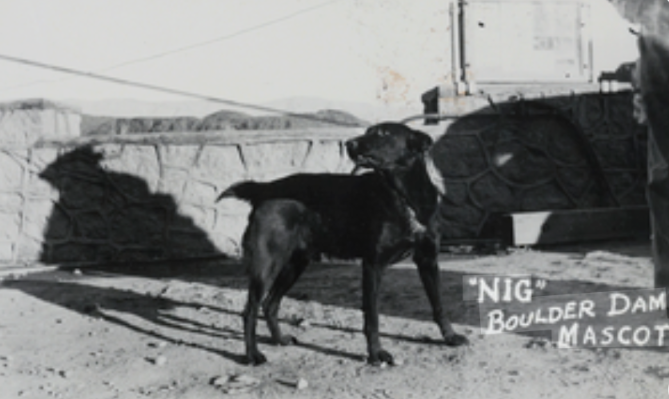
Back in the early 1930s, during one of America’s most ambitious engineering projects, something unexpected began wandering through the massive construction site of the Hoover Dam — a small black Labrador mix puppy who would soon become a living legend among the workers.
He wasn’t part of the official workforce.
He wasn’t trained, hired, or assigned.
But somehow, he belonged there anyway.
The puppy was born in Boulder City, Nevada, where workers for the dam project lived in tightly packed camps.
Life there was harsh, loud, and exhausting — a constant cycle of heat, dust, and dangerous labor. But in the middle of all that intensity, a stray pup began to roam freely among the buildings and workers.
He had no owner.
No fixed home.
Just curiosity — and an uncanny ability to befriend everyone he met.
The men started calling him Nig, a name based on the language of the time and his dark coat. More importantly, they started treating him like he was part of the crew.
And just like that, a mascot was born.
From the moment he arrived at the dam site, Nig acted like he had a job to do.
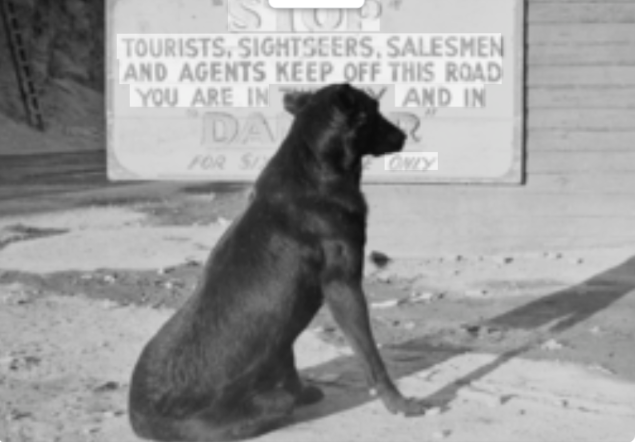
He followed workers into tunnels, climbed ladders, crossed narrow catwalks, and navigated the dizzying heights of the canyon with surprising confidence.
While the men worked with steel and concrete, Nig worked his way through their routines, always nearby, always watching, always moving.
He wasn’t just present — he was involved.
At the end of the day, when the work whistle blew, Nig would line up with the workers to ride back to Boulder City, as if he were just another member of the crew clocking out after a shift.
If he missed a ride? He’d simply find another.
Truck, cart, elevator — it didn’t matter. If it was connected to the dam, it was his transportation too.
What made Nig special wasn’t just his fearlessness — it was his independence.
Workers quickly realized something strange: he didn’t belong to anyone, but somehow, he belonged to everyone.
He would drift between crews, greeting familiar faces, following new ones, and moving through the massive construction site as if he had an internal map of every corner.
And the men loved him for it.
In a place defined by danger and exhaustion, Nig became something rare — a source of comfort.
A break in the noise.
A reminder that life could still be simple.
Even outside the dam, his reputation grew.
Back in Boulder City, Nig became something of a local celebrity. People fed him treats, spoiled him with attention, and watched him roam freely through town like he owned it.
But his generosity of spirit came with a downside — everyone wanted to feed him, and eventually, it made him sick.
So the workers stepped in.
They arranged for controlled feeding through the commissary and even pooled money to care for him properly, making sure he stayed healthy and looked after.
Nig wasn’t just a mascot anymore.
He was a responsibility everyone shared.
Over time, stories about him became part of dam folklore.
There were tales of him riding in executive cars, sitting confidently beside engineers, and even outsmarting strict routines just to be where he wanted to be.
Whether those moments were fully factual or slightly romanticized over time didn’t matter much — what mattered was what he represented.
He belonged.
In a place built by thousands of workers, under immense pressure and risk, Nig became the emotional thread that tied people together.
But like all working-site legends, his story eventually came to an end.
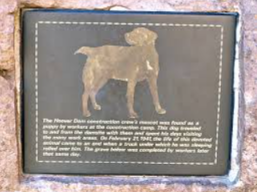
Nig’s life was cut short in 1941 after a tragic accident near the dam site.
Workers who had known him were devastated, and many insisted on honoring him in a way that reflected what he meant to them — not as property, not as a stray, but as a companion who had shared their daily lives.
A memorial was created near the dam, marking his resting place and preserving his story for those who still visit today.
What remains most powerful about Nig’s story isn’t just the history — it’s the feeling it leaves behind.
A dog born in hardship, wandering into one of the most demanding construction projects in the world, somehow became its heart.
Not through training.
Not through planning.
But through presence.
And maybe that’s why his story still resonates nearly a century later.
Because it reminds us that even in the most industrial, structured, human-built environments… something simple and alive can slip through the cracks and change everything.
A stray pup.
A construction site.
And a bond no blueprint could ever design.