He thought it would be funny.
A harmless little experiment.
Just a dog dad, surrounded by his four pups, deciding to see what would happen if he barked at them the way they bark at him.
It did not go as planned.
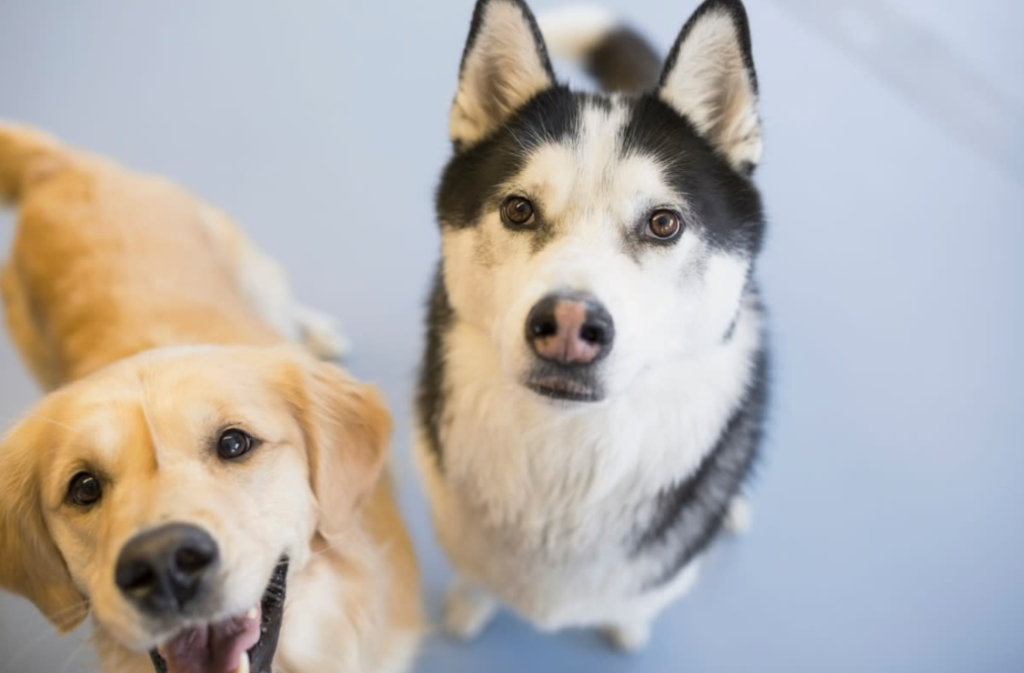
The video shows a man with his pack of dogs — a mix of golden retrievers and huskies — casually testing out a theory: if he barks first, will they respond like he does?
At first, it seems playful. Curious, even.
But the dogs don’t interpret it as a joke.
They interpret it as a challenge.
The first reaction comes immediately.
Confusion.
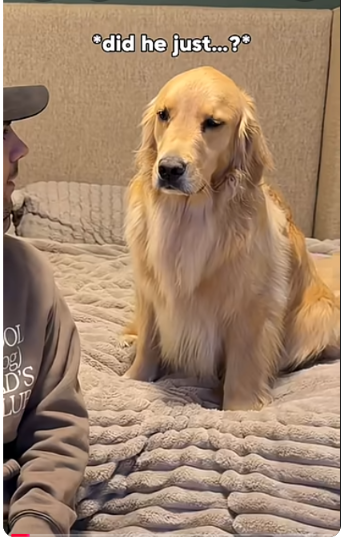
One dog stares like he’s trying to process whether this is allowed in the household rules.
Another doesn’t hesitate at all — he moves straight into correction mode, rushing toward dad with the energy of a dog who has decided this behavior is unacceptable.
Then things escalate.
The huskies, known for their vocal personalities, respond in full force.
Instead of backing down or playing along, they fire back with their own barrage of barks, almost as if forming a united front against what they perceive as absolute nonsense.
What started as a “fun idea” quickly turns into controlled chaos.
Dogs moving. Barking. Tugging. Reacting not with confusion alone, but with what looks very much like offense.
As if the message is clear:
“You don’t get to do that.”
One golden retriever takes it especially personally.
After a brief pause — the kind where you can almost see the thought process happening — he decides the only appropriate response is physical intervention.
He jumps in, grabs at dad’s clothing, and essentially ends the conversation altogether.
The energy in the room shifts fast.
This is no longer a prank.
It’s a group correction.
A collective decision that dad has stepped out of line.
And yet, from the outside, it’s impossible not to laugh.
Because there’s something undeniably human about the whole exchange — even if every participant has four legs and a tail.
The miscommunication.
The overreaction.
The immediate escalation.
But underneath the humor, there’s also something interesting happening.
Dogs don’t just hear barking as sound — they read it in context, tone, and situation.
And when a familiar human suddenly uses it in a way that breaks the normal pattern, it doesn’t register as imitation.
It registers as disruption.
That’s why the reaction is so strong.
To them, dad didn’t “try a funny sound.”
He changed the rules.
Eventually, the moment settles.
Energy drops.
Barking fades.
And the dogs return to their normal state — though not without lingering looks that feel suspiciously like judgment.
The kind that says:
“We’re going to remember this.”
And maybe that’s the real takeaway here.
Not that the dogs overreacted.
Not that dad caused chaos.
But that in a household where communication is usually predictable… even a small change in tone can flip the entire dynamic upside down.
One bark.
Four dogs.
And a dad who learned, very quickly, that in this house…
only the dogs get to start the conversation.