
He used to be loud.
Then, he wasn’t.
And for a long time, no one really understood why.
Petey, an American Bulldog, was once the kind of dog who barked frequently in the shelter environment.
But that changed after he was fitted with a bark collar—something meant to manage his noise, but which ultimately had a much deeper impact on him.
Instead of just quieting down, he went completely silent.
And that silence followed him into his new home.
Even after being adopted by his mom, Erin, Petey didn’t make a sound for months. No barking. No playful vocalizations.
No expressive noises that most dogs naturally use to communicate.
It was as if his voice had been turned off entirely.
But everything started to shift once he began to understand something important:
He was safe now.
Really safe.
Not a temporary situation. Not a conditional one. A real home where he wasn’t going to be corrected for simply being a dog.
Slowly, that silence began to crack.
First came small changes—slight reactions, more relaxed body language, moments of curiosity. And then, one day, something even more meaningful happened:
He used his voice again.
Not a bark out of stress.
Not a reaction to fear.
But something entirely different.
Joy.
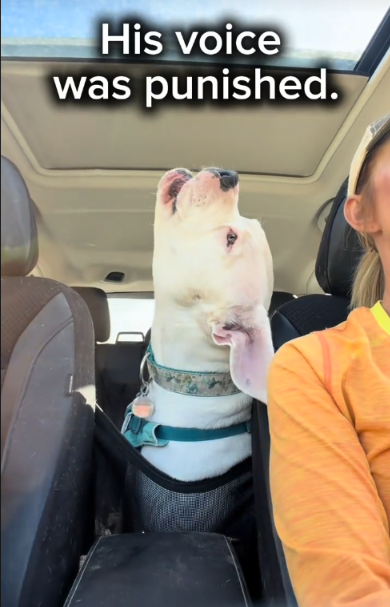
Petey began “singing” in the car during rides and occasionally at home—soft, expressive vocalizations that felt more like emotional release than noise.
It wasn’t just sound coming back.
It was personality returning.
His mom described it simply: he had learned that his voice was safe again—and that she would listen to him now.
That distinction matters more than it seems.
Because for dogs who have experienced suppression or correction-based training, vocalization isn’t just behavior—it’s confidence.
And Petey’s confidence didn’t return all at once.
It came in layers.
A small sound here.
A hesitant vocalization there.
Then longer, more expressive moments that filled the home with something it had been missing for a long time.
Viewers responded strongly to his transformation, especially because it represents something many rescue dogs go through in different ways:
The slow rebuilding of trust.
Not just in people—but in themselves.
Petey didn’t just learn to bark again.
He learned that he could.
That his communication wasn’t going to be punished or shut down anymore.
And that changed everything.
Now, his voice has become part of his personality again. He sings when he’s excited, when he’s in the car, and sometimes for no clear reason at all—just because he can.
And every sound he makes carries a quiet kind of relief.
Because this isn’t really a story about noise.
It’s a story about recovery.
About what happens when a dog who learned to stay silent finally discovers he doesn’t have to anymore.
And in that moment, something simple becomes something powerful:
A voice returns.
And so does the dog who was always behind it.