In a busy shelter, it’s easy for some dogs to disappear in plain sight.
They don’t bark for attention. They don’t jump up when people walk by. They don’t press against the front of their kennel hoping to be noticed.
They just… stop trying.
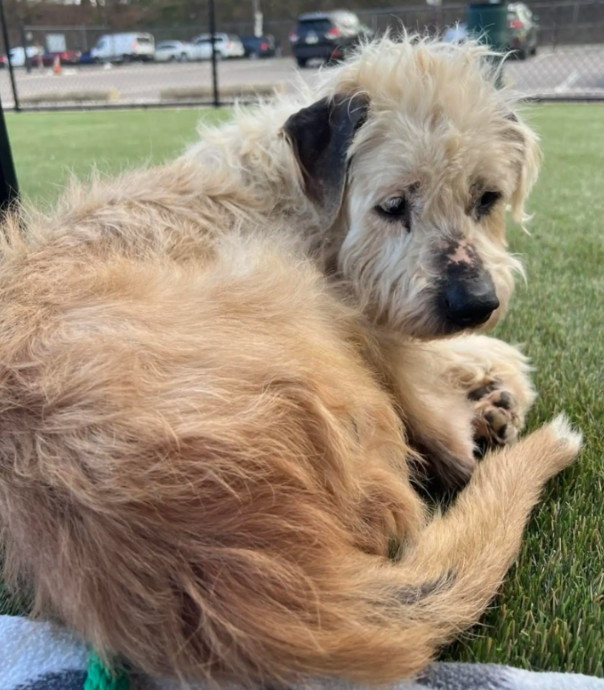
That was the case for one shelter dog who had become so withdrawn that staff began to worry he wasn’t just sad—he was shutting down completely.
He barely moved.
He lay quietly in his kennel, avoiding interaction, seemingly disconnected from everything happening around him.
For many shelter workers, this kind of behavior is heartbreaking because it signals something deeper than stress—it signals emotional collapse.
Dogs like this often arrive carrying unknown histories. Sometimes it’s trauma. Sometimes loss.
Sometimes simply the overwhelming shock of suddenly being in a loud, unfamiliar environment with no stability.
And in that kind of setting, even friendly dogs can fade into themselves.
Days passed like that. The dog remained still, uninterested in toys, uninterested in people, uninterested in the usual attempts to engage him.
He wasn’t causing problems—he was just absent in the way that matters most: emotionally.
In shelters, that’s often the hardest state to break.
Because it doesn’t look like misbehavior.
It looks like nothing at all.
Then someone noticed him.
A visitor who regularly works with shelter dogs began looking specifically for the ones who are overlooked—the ones who don’t naturally draw attention.
Dogs who are often described as “the quiet ones” or “the ones who just sit in the back.”
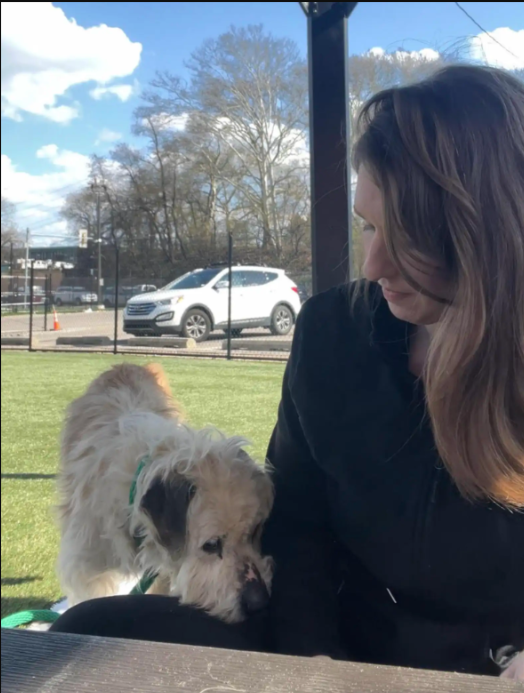
When she saw him, she didn’t rush past. She didn’t assume he was fine just because he was quiet. Instead, she paused and focused on him specifically.
And that small act changed the direction of his day.
She approached slowly, giving him space rather than pressure. No sudden movements. No expectations. Just presence.
At first, he barely reacted.
But something subtle shifted.
A glance.
A slight lift of the head.
The smallest acknowledgment that someone had finally stopped long enough to see him.
She spent time sitting nearby, letting him decide the pace.
This is often how trust begins in shelter environments—not through commands or stimulation, but through consistency and calm presence.
And slowly, the dog responded.
Not dramatically.
Not immediately.
But enough to show that he was still there underneath the shutdown.
For shelter staff and volunteers, these moments matter more than most people realize.
A dog that begins to re-engage—even slightly—has a better chance of recovery, both emotionally and behaviorally. It signals that the shutdown isn’t permanent.
It signals possibility.
Over time, dogs like this often begin to reconnect with the world in small steps. A willingness to stand. A brief interest in food.
A moment of curiosity toward a toy or a person’s voice. These changes might seem minor, but in context, they are enormous.
Because they represent a shift from withdrawal back into engagement.
Back into life.
This particular dog’s story is still unfolding, as many shelter recoveries do.
There is no instant transformation, no single moment where everything changes all at once.
Instead, there is a gradual rebuilding—trust layered over time, comfort restored piece by piece.
What stands out most is not how quickly he recovered.
It’s that someone stopped long enough to notice he needed help in the first place.
Because in a place filled with noise, movement, and constant change, it’s easy for the quietest dogs to go unseen.
And sometimes, all it takes is one person choosing not to look past them.
Just choosing to see them.
And stay.