For years, he didn’t really play.
Not because he couldn’t—but because no one ever showed him how.
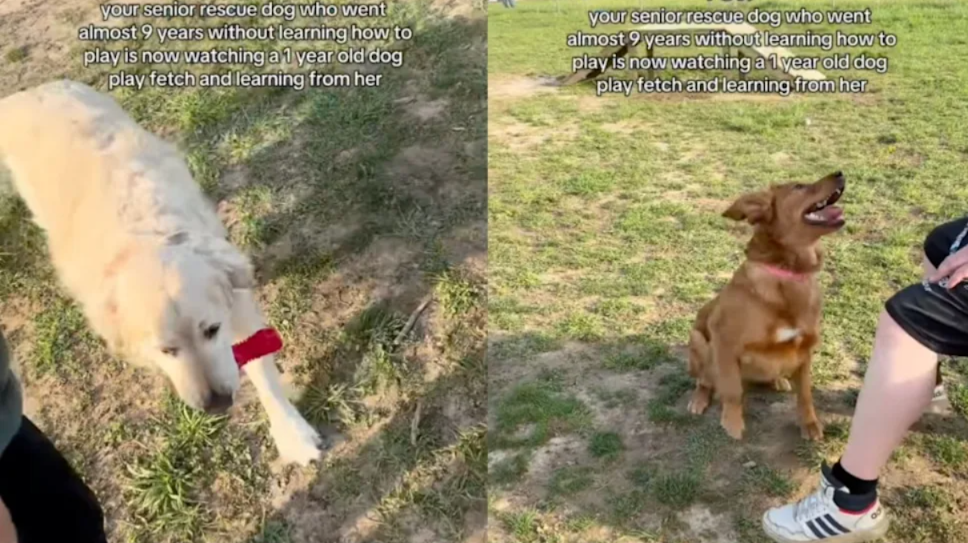
This senior rescue dog had spent most of his life without learning something many dogs pick up naturally: how to play.
Fetch, in particular, was completely unfamiliar to him. At nearly nine years old, he had simply never been taught.
So he watched instead.
And that’s where everything began to change.
In a quiet park setting, a younger Golden Retriever was playing fetch with ease—running after a ball, returning it, repeating the game with pure enthusiasm.
For most dogs, it would have been just another background moment.
But for him, it was something else entirely.
He watched carefully.
Not distracted. Not indifferent.
Interested.
Curious in a way that hadn’t really surfaced before.
And then, something subtle shifted.
Instead of staying on the sidelines like he always had, the senior dog began to follow. First just observing more closely.
Then moving a little nearer. Then trying it himself.
At first, it wasn’t perfect.
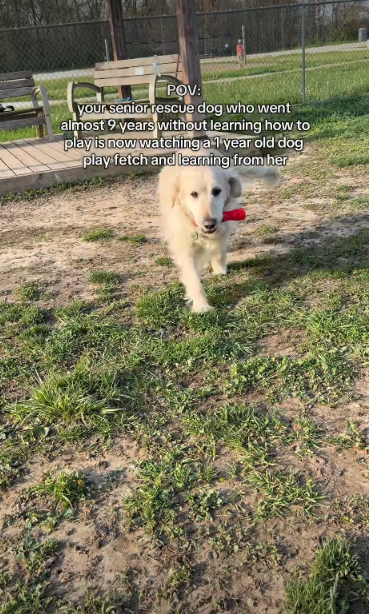
There was hesitation in his movements. Uncertainty in how he engaged with the toy. This wasn’t muscle memory—it was discovery.
A dog learning something brand new in what many would assume are his “later years.”
But what stood out wasn’t his skill.
It was his willingness.
Because despite never having played like this before, he kept going.
Step by step, he began to understand the rhythm of the game. A toy thrown. A chase. A return.
Something clicked—not instantly, but gradually, as repetition replaced confusion.
And in that simple structure, something long dormant began to return.
Engagement.
Energy.
Confidence.
For the people watching, the moment carried a deeper weight than just a dog learning fetch. It was a reminder that development doesn’t always stop at a certain age.
Sometimes it just pauses—waiting for the right environment, the right influence, the right moment to reappear.
His story reflects something many rescue workers see but don’t always get to capture on video: dogs who missed early social development can still learn later in life.
They can still adapt, still connect, still grow in ways that defy assumptions about age.
In his case, the catalyst wasn’t formal training.
It was observation.
Another dog simply living fully in a way he had never been shown.
And that mattered more than anything.
As the session continued, he became more comfortable. What started as hesitation slowly turned into participation. Not perfect, not polished—but real.
A dog who had spent years without this kind of play was now part of it.
That alone changed the tone of the moment.
Because rescue stories aren’t only about survival or adoption. They are also about rediscovery.
About what happens when an animal is finally given space to explore parts of life that were never accessible before.
For senior dogs especially, these moments carry a different kind of meaning. They aren’t just learning new behavior—they’re often experiencing emotional renewal.
A return to curiosity that may have been buried under years of uncertainty or lack of opportunity.
And while not every dog learns in the same way or at the same pace, this one did something important:
He tried.
Again and again.
What makes his story resonate isn’t that he became perfect at fetch.
It’s that he became willing to participate in something new at all.
In the end, the image that stays isn’t just a senior dog playing in a park.
It’s a dog who, after years of not knowing how to play, finally decided that maybe he could.