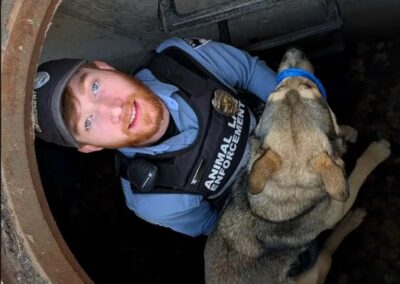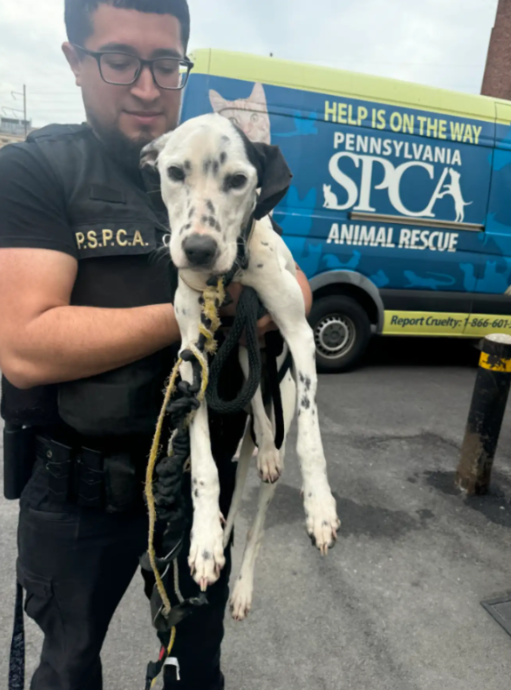
It looked like the worst kind of scene.
In a quiet alley in Philadelphia, rescuers arrived expecting uncertainty—but nothing prepared them for what they actually saw.
A Dalmatian lay completely still on the ground.
Not moving.
Not reacting.
Just… there.
Her body was so thin it was immediately clear she had endured prolonged neglect.
And around her neck were heavy ropes, tightly bound, frayed from time and exposure.
At first glance, she looked lifeless.
So much so that the rescuers initially feared they were too late.
But then something small changed.
A moment of hesitation. A closer step forward. A pause where someone refused to assume the worst without confirming it.
And then—barely noticeable at first—a breath.
She was alive.
Barely.
That discovery shifted everything immediately into urgency.
There was no time to waste. The dog was too weak to stand, too exhausted to respond.
One of the rescuers carefully lifted her into their arms, carrying her out of the alley and into safety before she could slip any further away.
Every second mattered.
At the veterinary clinic, the first priority was stabilization.
The ropes were carefully removed from her neck, revealing wounds beneath—evidence of how long she had been restrained or trapped in harsh conditions.
Her body was in critical condition, severely underweight and struggling to regulate basic functions.
She was given fluids, warmth, and constant monitoring.
But beyond the medical care, there was something else that mattered just as much: presence.
People stayed with her.
Watched over her.
Refused to let her experience recovery alone.
Because dogs like her don’t just need treatment—they need reassurance that what happened before is not what life will continue to be.
Veterinarians later estimated she was around two years old, though her condition made exact assessment difficult.
Malnourishment and neglect often distort development, making young dogs appear older or more fragile than they truly are.
What mattered more than age, though, was response.
And slowly, she began to respond.
At first, it was small—slight movement, awareness of touch, brief moments of engagement.
Then came more noticeable signs: stability when handled, willingness to eat, and gradual return of energy.
Day by day, she improved.
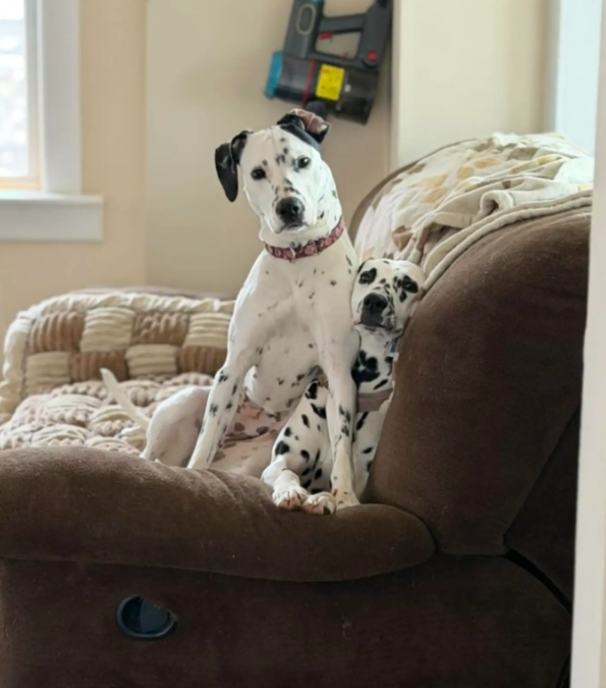
What had once looked like a lifeless body in an alley was now a recovering dog with increasing strength and presence.
Her personality, once buried under exhaustion and trauma, started to surface. Gentle. Calm.
Surprisingly affectionate, even after everything she had been through.
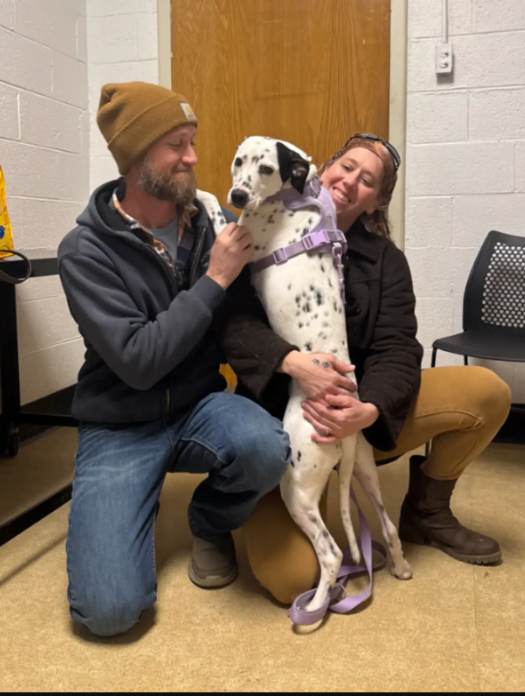
That contrast is what struck the rescue team most.
Not just what she endured…
but how she still responded to kindness.
Her recovery wasn’t instant, and it wasn’t easy. Healing from severe neglect takes time, patience, and consistency.
But she had already survived the hardest part: being found in time.
Now, her story shifted from emergency to rebuilding.
Warm bedding replaced cold concrete.
Regular meals replaced starvation.
Gentle care replaced abandonment.
And slowly, the dog who had once been found motionless in an alley began to look like something else entirely.
Not a victim frozen in time…
but a survivor learning how to live again.
Because sometimes rescue isn’t just about pulling an animal from danger.
It’s about staying long enough after that moment to help them realize they don’t have to fight to stay alive anymore.