At first, it looked like something funny.
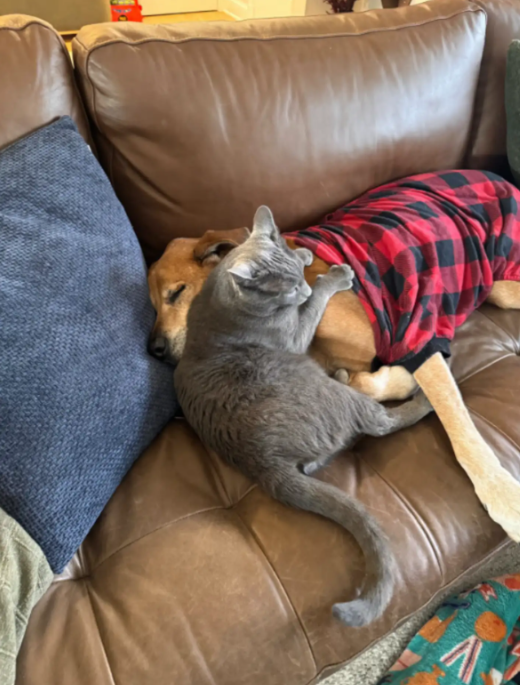
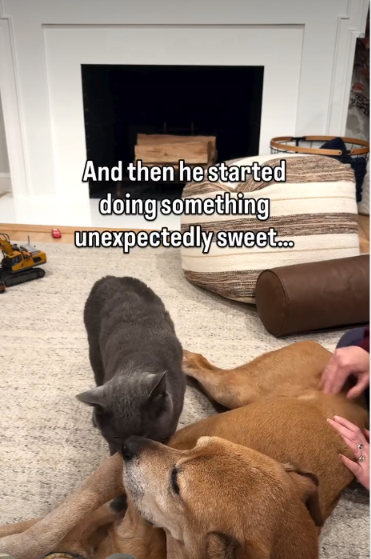
A cat gently placing its paws on a dog’s body—pressing, shifting, and repeating the motion as if it were giving a massage.
It wasn’t aggressive.
It wasn’t rough.
It almost looked… intentional.
The dog, meanwhile, didn’t seem bothered at all. In fact, he appeared completely relaxed, accepting the attention as if it were the most normal thing in the world.
But what really caught the owner off guard wasn’t just the behavior—it was how consistent it was.
Again and again, the cat returned to the dog, placing its paws on him in a slow, rhythmic motion.
It looked uncannily like kneading—an instinct cats often display when they feel safe, calm, or emotionally settled.
At first, it was easy to assume it was just random play. But over time, a pattern emerged.
The cat wasn’t just interacting.
It was caring.
And that’s when the meaning started to shift.
Feline behavior like kneading is deeply rooted in early development.
Kittens knead their mother while nursing, and many carry that behavior into adulthood as a way to self-soothe or express comfort.
When adult cats knead, it’s often linked to feelings of safety, affection, or emotional bonding.
So when a cat directs that behavior toward another animal—especially a dog—it’s rarely meaningless.
It’s communication.
In this case, the dog wasn’t just a passive recipient. He had become part of the cat’s comfort system.
A living presence that provided stability, familiarity, and calm.
The owner eventually began noticing more context clues. The cat didn’t behave this way with everyone.
It wasn’t a generalized habit—it was specific. Focused. Almost ritualistic.
And the dog responded in kind.
No tension. No avoidance. Just acceptance.
That quiet mutual understanding is what made the moment feel so powerful.
Because what initially looked like a “massage” wasn’t really about massage at all.
It was about bonding.
Cats often use touch-based behaviors like grooming, licking, or kneading to express trust and affiliation with other animals they accept as part of their social circle.
While it may appear strange to human observers, in feline social structure, these actions are deeply meaningful.
In this household, the cat had essentially extended that same language to the dog.
And the dog understood it in his own way—not through interpretation, but through response.
He stayed still.
He relaxed.
He allowed it.
That kind of interspecies interaction doesn’t happen through training or instruction.
It develops through repeated exposure, shared environment, and emotional safety over time.
What makes this moment resonate isn’t the novelty of a cat massaging a dog.
It’s the implication underneath it.
That two very different animals, with very different instincts, had developed a shared rhythm of trust without anyone forcing it.
No commands.
No structure.
Just behavior meeting behavior until something consistent formed.
And for the owner watching it unfold, the realization came slowly but clearly:
this wasn’t just cute.
It was communication.
A cat expressing comfort the only way it naturally knows how.
A dog accepting it without resistance.
And a quiet, ongoing exchange that said more than either of them could ever explain.
Because sometimes, the most meaningful bonds don’t look like connection at all at first glance.
Sometimes, they look like a cat kneading a dog…
and a dog simply staying still, because somehow, he understands.