At first, it didn’t seem like a problem.
Just a very loved dog.
When a woman began paying closer attention to her grandmother’s daily routine, she noticed something unusual—her dog, a beagle named Boomer, was being fed… constantly.
Not once.
Not twice.
But over and over again throughout the day.
At first glance, it almost looked like spoiling. Extra treats. Extra meals.
The kind of thing that might make you smile—until you realized how serious it had become.
Because Boomer wasn’t just well-fed.
He was dangerously overweight.
When his granddaughter finally stepped in and took a closer look, the numbers told the story clearly.
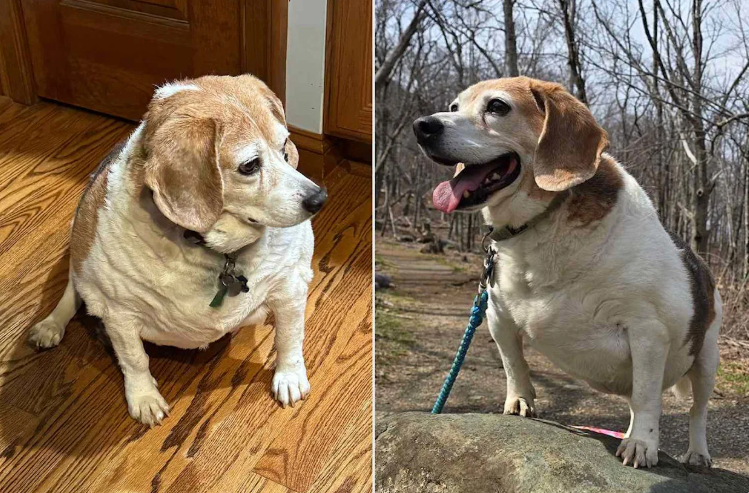
Boomer weighed over 60 pounds—far beyond a healthy weight for a beagle. He struggled with basic movement, even simple things like standing up or walking became difficult.
And that’s when the truth started to surface.
This wasn’t overindulgence.
It was something much deeper.

Her grandmother had dementia.
And because of it, she couldn’t remember whether she had already fed him.
So she fed him again.
And again.
And again.
Each time believing she was doing the right thing.
Each time acting out of love.
Dementia doesn’t just affect memory—it affects decision-making, routine, and perception.
In this case, it turned something as simple as feeding a pet into an unintended cycle that slowly put Boomer’s life at risk.
The hardest part wasn’t identifying the problem.
It was responding to it.
Because stepping in meant more than adjusting a feeding schedule—it meant navigating a deeply emotional situation.
Her grandmother loved those dogs. They were part of her daily life, her comfort, her sense of purpose.
Taking control of Boomer’s care wasn’t just practical.
It was personal.
So the family approached it carefully.
Eventually, Boomer was brought into his granddaughter’s home, where she could monitor his health more closely.
The first step was simple but critical: reducing his meals from as many as eight times a day down to just two controlled feedings.
It wasn’t easy at first.
Boomer had grown used to constant food. He begged. He expected more.
And like many dogs adjusting to a new routine, he had to relearn what “enough” felt like.
But slowly, things began to change.
With portion control, low-calorie treats, and gentle exercise, Boomer started to lose weight. Not overnight. Not dramatically.
But steadily.
Within months, he had dropped over 20 pounds.
And with that weight loss came something even more important:
Relief.
He could move again.
Climb steps.
Walk without strain.
Even enjoy time outdoors—something that had once been nearly impossible.
What makes this story so emotional isn’t just the transformation.
It’s the perspective.
Because it would be easy to assign blame—to see the situation and assume neglect or irresponsibility.
But that wasn’t the truth.
The grandmother wasn’t harming the dog.
She was loving him.
In the only way her mind allowed her to understand in that moment.
And that’s what stayed with the family most.
That even in confusion, even in memory loss, the intention remained the same:
Care.
Affection.
Connection.
Today, Boomer is healthier, more active, and living a completely different life. But his story carries something beyond weight loss or recovery.
It’s a reminder that sometimes, the situations we see on the surface don’t tell the full story.
Sometimes, what looks like a problem…
is actually love, just expressed through a lens that’s been quietly changed.
And sometimes, helping means stepping in—not to replace that love…
but to protect it.