At first, he didn’t move.
Not because he was calm—but because he was terrified.
Curled into the corner of a kennel, his body folded in on itself, he tried to make himself as small as possible.
Smaller than the space. Smaller than the fear. Smaller than the world that had already been too much for him.
He was severely emaciated.
Skin stretched tightly over bone. Weak. Fragile.
The kind of condition that tells a story without needing words—neglect, abandonment, and too many days without enough food or safety.
But what stood out even more than his body…
Was his fear.
He didn’t bark. Didn’t approach. Didn’t even look hopeful.
He just stayed there.
Still.
Watching.
Waiting.
As if any movement might make things worse.
Dogs in shelters often react in different ways—some jump, some cry, some beg for attention. But dogs like him?
They disappear.
Not physically.
Emotionally.
They shut down.
That’s exactly what this dog had done.
Until someone decided to do something different.
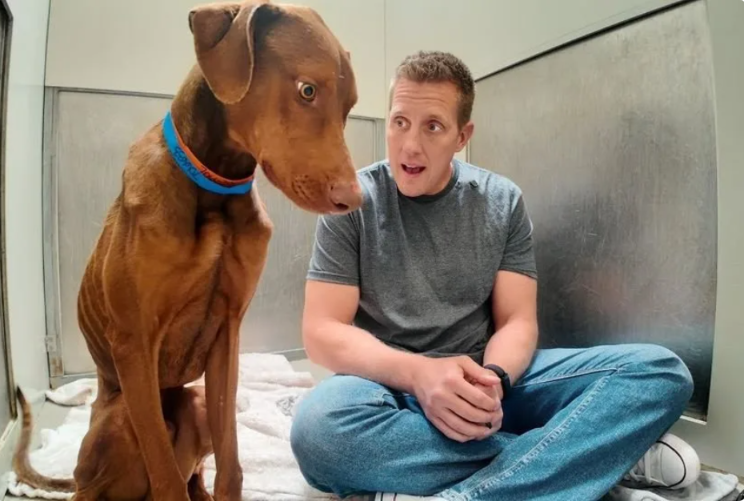
A volunteer didn’t try to rush him. Didn’t pull him out. Didn’t force interaction.
He just… sat down.
Inside the kennel.
On the floor.
At the dog’s level.
And waited.
That’s it.
No commands. No pressure. No expectations.
Just presence.
At first, nothing changed.
The dog stayed curled up, still unsure, still guarded. But something subtle began to shift—not in his body, but in the space between them.
Because for the first time in a long time, nothing was being asked of him.
No sudden movements.
No loud energy.
Just quiet.
And slowly… he started to notice.
His eyes lifted.
Not fully—but enough.
Then his body shifted, just slightly, as if testing whether it was safe to exist a little more openly in that moment.
This is the part most people miss.
Transformation doesn’t always start with action.
Sometimes it starts with permission.
The permission to feel safe.
The permission to not be afraid—just for a second.
And that second grew.
The dog began to move closer. Not quickly. Not confidently. But intentionally. Each step small, cautious, and incredibly brave.
Because for him, this wasn’t curiosity.
It was risk.
But something about the calm presence in front of him made that risk feel… worth taking.
And then it happened.
He leaned in.
Not fully. Not dramatically.
Just enough to close the distance.
And in that moment, everything changed.
The dog who had been trying to disappear… started to come back.
You could see it in his posture. In the way his body softened. In the way his eyes shifted from fear to something else—something lighter, something closer to trust.
All from one simple act.
Someone sitting with him.
That’s what makes this story stay with people.
Not the rescue itself.
Not the condition he was found in.
But the realization that what he needed most wasn’t immediate fixing.
It was connection.
Because even the most broken-looking dogs aren’t beyond reach.
They’re just waiting for the right kind of approach.
One that doesn’t demand.
One that doesn’t overwhelm.
One that simply says:
I’m here. And I’m not going anywhere.
And sometimes…
That’s enough to bring a dog back to life.