Some dogs enter a shelter already carrying stories too heavy for their bodies.
This senior dog was one of them.
When he arrived, he wasn’t in good shape. His back legs were severely damaged—so badly that many assumed there was no realistic path forward.
The kind of case that, in a world of limited resources, often ends with a heartbreaking recommendation no one wants to say out loud.
But someone refused to accept that outcome.
Instead of giving up, the rescue team made a different choice. They sought another veterinary opinion. That decision alone changed everything that came next.
What followed wasn’t quick or simple.
It was medical intervention, difficult procedures, and a long recovery process that required patience most people never see.
His damaged hind limbs ultimately had to be amputated. A devastating sentence on paper—but not the end of his story.
Because what he lost in anatomy, he slowly regained in possibility.
After surgery, the shelter outfitted him with a mobility cart—his “new wheels.”
At first, movement was awkward. Any dog adjusting to a cart has to relearn balance, direction, and confidence.
But dogs don’t measure life in the same way humans do. They measure it in access, freedom, and connection.
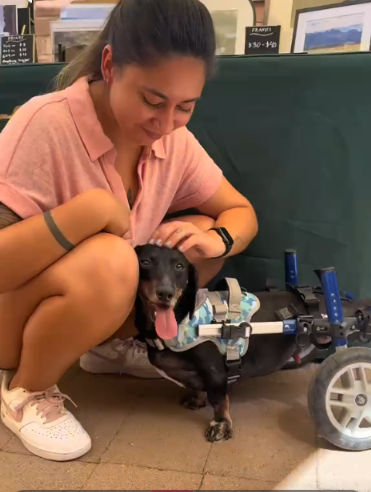
And once he understood what the wheels meant, everything changed.
He ran.
Not cautiously. Not hesitantly. He ran like a dog who had just been told the world was open again.
Inside the rescue, he became something of a quiet symbol. Not because he was the loudest or the most energetic, but because he represented what patience and care can restore.
He interacted with other dogs, learned the rhythm of sanctuary life, and slowly built trust with the people around him.
He even became part of the shelter’s community presence—featured in events, included in outreach materials, and celebrated not as a “disabled dog,” but as a survivor with personality, curiosity, and unmistakable joy.
But the most important part of his story wasn’t what happened in the shelter.
It was what came after.
Four years passed. Four years of waiting while most people walked past without stopping long enough to see past his condition.
Senior dogs, especially those with medical challenges, are often overlooked—not because they lack love to give, but because their needs feel intimidating to potential adopters.
Still, he waited.
And the rescue team waited with him.
Until one day, someone finally didn’t walk past.
The adoption wasn’t dramatic in the way viral videos sometimes are. There was no theatrical moment of instant transformation.
Just a simple shift: a dog leaving the place he had lived for years… and stepping into a home where he would no longer be defined by what he lacked.
At home, something subtle happened first. He didn’t immediately understand that this new space was permanent.
Many rescue dogs don’t. They test safety slowly. They observe. They wait for patterns to repeat.
But nothing bad came.
No uncertainty. No instability. No return to the shelter.
Just steady care.
And over time, the dog who once had to be lifted over thresholds began navigating his world with growing confidence on his wheels.
Movement became normal again—not medical, not special, just part of daily life.
What makes stories like this resonate so deeply isn’t the disability or the recovery. It’s the persistence underneath it all.
The refusal to treat limitation as the end of identity.
He didn’t become “fixed.”
He became supported.
And that difference matters.
Because in the end, what changed his life wasn’t just surgery or equipment. It was time, patience, and the decision by one rescue—and eventually one adopter—to believe that a senior dog with a difficult body still deserved a full future.
And that belief carried him exactly where he had always been meant to go: forward.