Time-out is usually meant to be a quiet moment of reflection.
A child sits still.
A parent steps away.
And the world goes briefly silent.
But in one home, that silence didn’t last long.
Because a French Bulldog decided it didn’t feel right to sit it out alone.
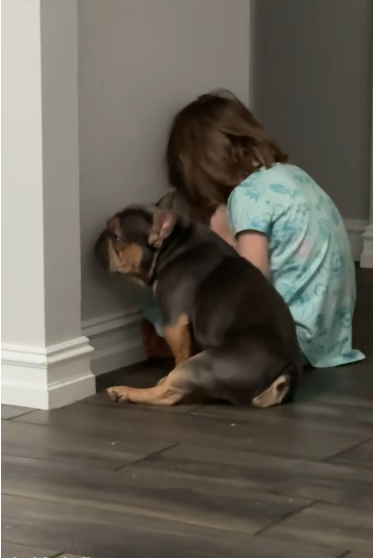
In a now-viral clip, a young girl is seen sitting in time-out, facing the wall as she processes whatever moment led her there. She’s calm, quiet, and clearly in “pause mode,” as kids often are in those situations.
Then something unexpected happens.
Her French Bulldog walks over.
And sits down right beside her.
Not pacing. Not playing. Not leaving.
Just sitting.
Exactly like her.
Same direction. Same posture. Same stillness.
It’s almost as if he studied the scene and decided: If she’s in time-out, I’m in time-out too.
There’s no confusion in his behavior—only presence.
He doesn’t try to interrupt. He doesn’t try to “fix” anything. He simply stays close, as if the most important rule in that moment is not about discipline at all, but companionship.
At one point, he even mirrors her posture so closely it becomes impossible to miss the intent behind it.
He sits facing the same direction, body relaxed but attentive, like a quiet partner serving the same sentence.
For a moment, the punishment stops feeling like isolation.
It becomes shared space.
And that’s what made the clip spread so quickly online.
Not the time-out itself.
But the instinct behind it.
Viewers immediately recognized the emotional layer in the moment. The dog wasn’t reacting to authority or understanding the concept of discipline.
Instead, he was responding to something simpler and more universal: someone he cared about was separated from the group.
And he didn’t want that.
French Bulldogs, in particular, are known for their strong attachment to their families. They’re naturally people-focused dogs—often described as loyal, affectionate, and highly tuned into household emotional dynamics.
That tendency shows up in small but meaningful ways, like following family members from room to room or staying close during quiet moments.
In this case, it just happened to be a time-out.
What stands out most is how instinctive the response is.
There’s no training that teaches a dog to “join” a time-out.
No command that tells them to sit in solidarity.
It’s something else entirely—social awareness filtered through attachment.
To a dog, separation doesn’t always come with context. A child sitting apart from the group can register as simply: my person is alone.
And for a companion breed, that’s often enough to trigger proximity behavior.
So he sits.
Not because he understands consequence.
But because he understands connection.
The girl, for her part, remains in her time-out, but the emotional tone of the moment shifts. What was meant to be separation becomes shared quiet.
A pause, not in isolation, but in company.
And that subtle shift is what people responded to most.
Because it reframes something familiar in many households.
Even in structured moments like discipline, the bond between child and dog doesn’t pause.
It adapts.
There’s no dramatic resolution here.
No big lesson spoken aloud.
Just a dog choosing to sit where his person sits, as if the most natural thing in the world is not to fix the moment—but to be in it together.
And sometimes, that’s all companionship really looks like.
Not excitement. Not action.
Just sitting quietly beside someone who doesn’t want to be alone.