Sometimes the most meaningful lessons don’t come from teaching.
They come from watching.
And in one small kitchen moment, a toddler and his golden retriever turned an ordinary meal into something quietly unforgettable.
In a video shared online, a family sits together at the counter—parents, their toddler, and their golden retriever sitting patiently nearby, watching everything unfold.
On the table, the setup is simple.
The parents each have one piece of food.
The toddler has two.
And the dog… has none.
It doesn’t take long for the moment to reveal its purpose.
There’s no instruction being shouted. No guiding hand correcting behavior. Just a quiet pause where something important is about to happen.
The family is watching—not interfering.
Waiting.
The toddler looks at his plate.
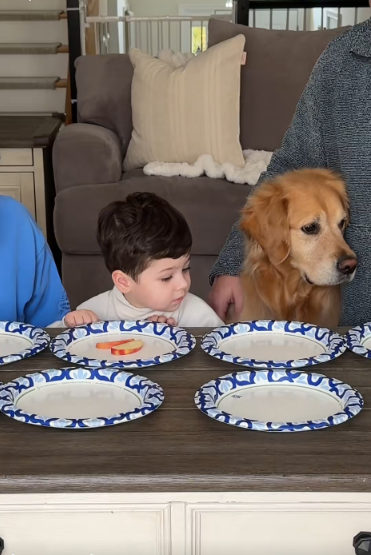
Then at the dog.
And after a brief moment of decision-making that only a child can make so honestly, he reaches over and gives one piece of his food to the golden retriever.
No hesitation. No drama.
Just sharing.
The dog, calm and attentive, accepts it gently.
No jumping. No grabbing. Just a soft, grateful response that matches the energy of the moment perfectly.
And just like that, the balance of the table changes.
Two pieces become one.
And kindness becomes visible.
What makes this moment so powerful isn’t complexity—it’s simplicity.
A toddler, still learning how the world works, chooses to include someone else in something small but meaningful.
And the dog, as golden retrievers often do, responds with patience and quiet trust.
Golden retrievers are well known for their gentle temperament and strong emotional sensitivity around children. They often mirror calm behavior and thrive in family environments where interaction is consistent and positive.
In moments like this, that temperament becomes more than personality—it becomes connection.
Online viewers reacted strongly to the clip, not because it was surprising, but because it felt familiar in a deeper way.
Many parents recognized the scene immediately: the early stages of empathy forming in real time.
Not taught.
Discovered.
The toddler didn’t act for attention.
He wasn’t prompted or corrected.
He simply noticed a presence beside him and decided that sharing made sense.
That’s what made the moment stand out.
And for the dog, it wasn’t about the food.
It was about participation.
Being included in the rhythm of family life, even in something as ordinary as a snack.
Child development experts often point out that interactions like these—especially with animals—can help children develop early empathy, cooperation, and emotional awareness.
But in practice, none of that feels academic.
It just looks like kindness happening naturally.
The rest of the scene unfolds quietly.
The dog stays close.
The toddler continues eating.
And the simple exchange settles into something bigger than itself—a shared understanding that doesn’t need words.
There’s no dramatic ending.
No transformation moment.
Just a normal kitchen, a family together, and a small decision that carried more meaning than anyone probably realized in the moment.
But that’s often how these stories work.
They don’t announce themselves as important while they’re happening.
They only become meaningful when you look back and realize what they showed.
A child learning generosity.
A dog receiving it without expectation.
And a moment that didn’t last long… but stayed with everyone who saw it.
Because sometimes the most powerful lessons in empathy don’t come from teaching at all.
They come from a toddler with two pieces of food…
and a golden retriever who had none.