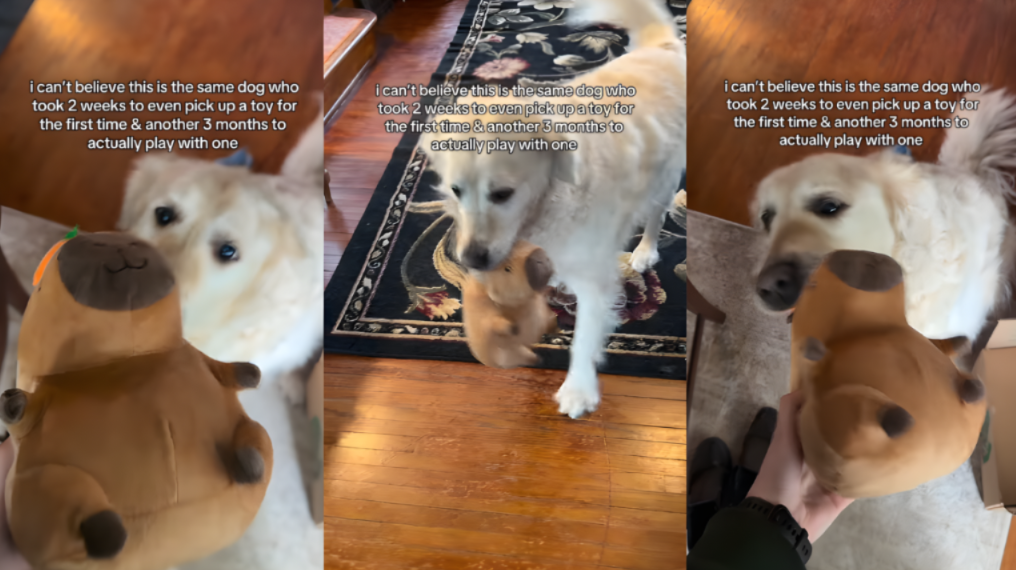
When he first arrived, he didn’t understand toys.
Not really.
He would look at them—soft, colorful, squeaky things scattered across the room—but never reach for them. No curiosity. No excitement.
Just hesitation, like he wasn’t sure those objects were meant for him at all.
For a senior Golden Retriever named Bruce, even the simplest joys of “dog life” didn’t come naturally at first.
Because before rescue, life hadn’t included comfort.
It hadn’t included play.
It hadn’t included safety.
So when everything suddenly changed—when he was finally placed in a home where kindness replaced survival—it didn’t immediately feel like freedom.
It felt unfamiliar.
And unfamiliar, for dogs like Bruce, often feels like fear.
In those early weeks, his world was small.
Careful movements. Slow steps. Watching before acting.
Even in a safe home, he carried the habits of a dog who had learned not to expect too much.
Especially not joy.
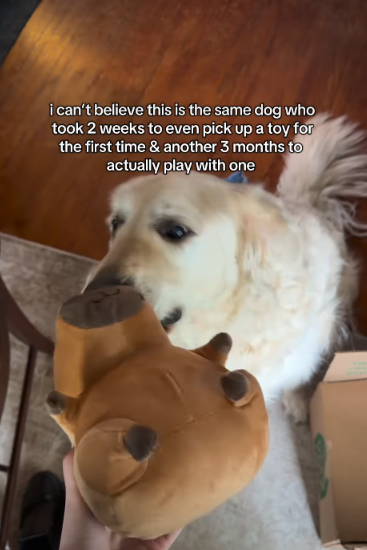
So when a toy was placed in front of him, he didn’t react the way most people expect a dog to react.
He didn’t grab it.
He didn’t shake it.
He didn’t light up instantly.
He simply looked at it.
As if waiting for it to disappear.
Because when life has taught you that good things don’t always last, you don’t rush toward them.
You hesitate.
But the people caring for him didn’t rush him either.
They didn’t push excitement. They didn’t force interaction.
They just kept offering small moments—gentle routines, calm presence, and quiet encouragement that nothing here was going away.
And that consistency matters more than most people realize.
Because trust doesn’t arrive in a single breakthrough moment.
It builds slowly, in repetition.
Day after day.
Week after week.
Until something inside a dog finally decides:
Maybe this is real.
For Bruce, that shift didn’t happen dramatically.
It happened quietly.
First, he stopped avoiding the toys completely.
Then he started sniffing them.
Then touching them.
Then one day—after what felt like a long stretch of waiting—something different happened.
He picked one up.
Carefully at first.
Like he still wasn’t entirely sure he was allowed to enjoy it.
And then, something even more surprising followed.
He played.
Not cautiously.
Not hesitantly.
But fully.
He tugged it. Carried it. Paraded it around the room like it was the most important thing in the world.
His energy changed in a way that didn’t just look like play—it looked like relief.
Like something inside him had finally loosened.
That’s the part people don’t always see when they watch rescue transformations.
It’s not just about learning what toys are.
It’s about unlearning the idea that nothing good belongs to you.
And once that belief starts to fade, everything else opens up.
The dog who once didn’t understand joy begins to seek it.
The dog who once hesitated begins to engage.
And the dog who once lived carefully begins to live fully.
Bruce didn’t become a different dog.
He just became the version of himself that had been waiting under everything he survived.
And now, instead of sitting back from life, he’s in it.
Toys scattered across the floor aren’t confusing anymore.
They’re invitations.
And for the first time in a long time…
He’s accepting them.