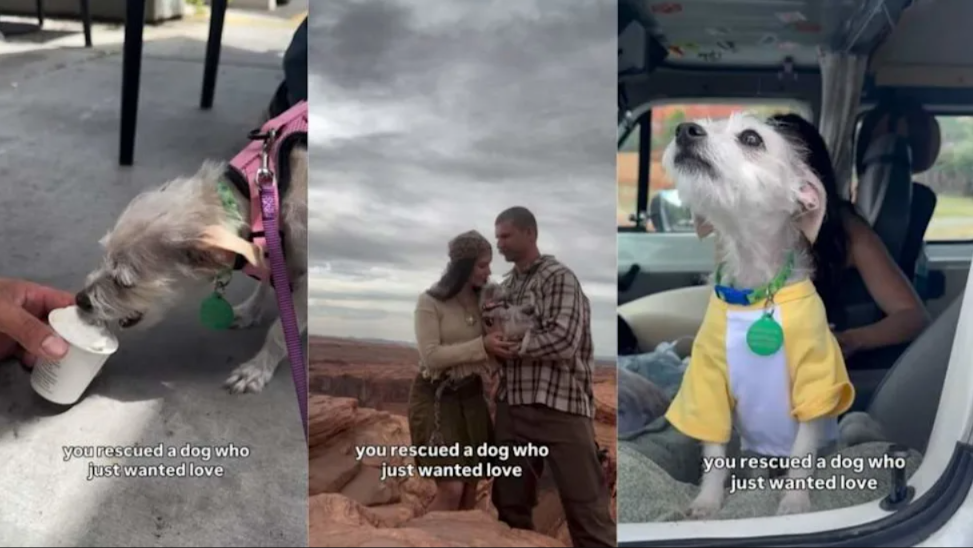
She didn’t demand attention.
She didn’t push forward when people passed her kennel.
She didn’t try to perform or stand out.
She just waited.
Quietly.
The kind of waiting that shelter dogs learn when hope becomes something you hold carefully instead of something you chase loudly.
Because in a shelter, being “seen” is everything—and for a long time, she wasn’t.
She was labeled like so many others. Just another dog in a crowded system. Another kennel.
Another face behind bars hoping someone would stop long enough to notice.
But if you looked closer, there was something different about her.
Not dramatic. Not obvious.
Just a softness.
A stillness that wasn’t defeat—but restraint. Like she had learned not to expect too much, even though something inside her still wanted to try.
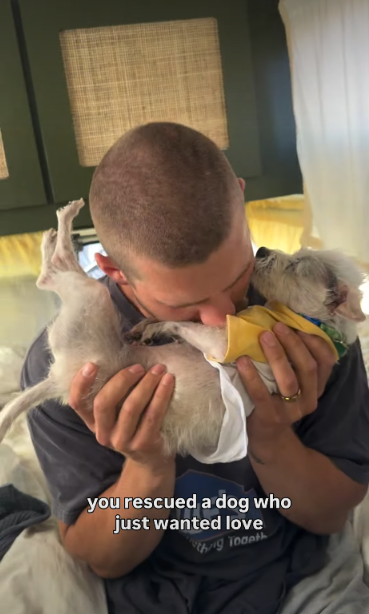
That’s what makes these moments so powerful when they finally happen.
Because eventually, someone does stop.
Not because she was the loudest or most attention-grabbing dog in the room—but because she was still there, still trying in her own quiet way.
And that was enough.
The connection didn’t happen instantly in a flashy, cinematic way. It didn’t need to.
It happened in small moments—eye contact that lingered a little longer than expected, a soft response when spoken to, a tail that started to move again after being still for too long.
That’s what rescue workers recognize immediately:
the moment a dog starts believing again.
She didn’t transform into a different dog overnight.
She didn’t suddenly become someone new.
What changed was simpler than that.
She got a chance.
A real one.
Not just passing interest. Not just temporary attention.
But someone willing to see her beyond the kennel, beyond the stress, beyond the environment that had made her shrink into herself.
And once that happened, something inside her began to shift.
She leaned in instead of pulling away.
She responded faster.
She started to follow instead of freeze.
It wasn’t loud.
But it was real.
And that’s what adoption stories like this are built on—not dramatic rescue moments, but quiet recognition.
The moment a person looks at a dog and doesn’t see “limited time” or “overlooked” or “just another shelter case.”
They see potential.
Not for perfection.
But for connection.
For a life outside the kennel walls.
For mornings that don’t start with uncertainty.
For evenings that end with safety instead of waiting.
And for her, that chance became the turning point.
Because shelter dogs don’t need grand gestures to change their trajectory.
They need consistency.
They need patience.
They need someone willing to meet them where they are, not where they’re expected to be.
Once she got that, everything else followed naturally.
The hesitation softened.
The distance disappeared.
And what was once a quiet, overlooked presence became something entirely different:
a dog beginning to trust that she wasn’t invisible anymore.
Her story isn’t about being the most broken or the most dramatic case in the shelter.
It’s about something far more common—and far more hopeful.
A dog who only needed someone to stop long enough to realize:
she wasn’t asking for much.
Just love.
And once she finally got it…
she didn’t let go.