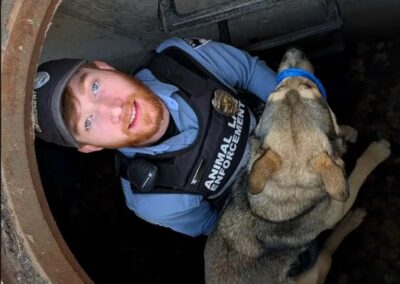
He was so small, he barely registered against the cold roadside where he was found.
A tiny puppy, locked inside a crate and abandoned in New Jersey, left in a state so severe that rescuers later said he had effectively been “left to die.”
What they discovered wasn’t just neglect.
It was survival hanging on by the thinnest thread.
The puppy, later named Firefox, was found along a road in Marlboro after someone alerted authorities to the abandoned crate.
Inside, they found a heartbreaking scene — a dog so severely malnourished he was barely able to move, weighing only around three pounds.
His condition was critical.
Veterinarians later confirmed that his body condition score was the lowest possible level before death. In simple terms, he was hours — not days — away from becoming another statistic.
He couldn’t stand.
He couldn’t walk properly.
Even basic movement seemed like a struggle his body could no longer support.
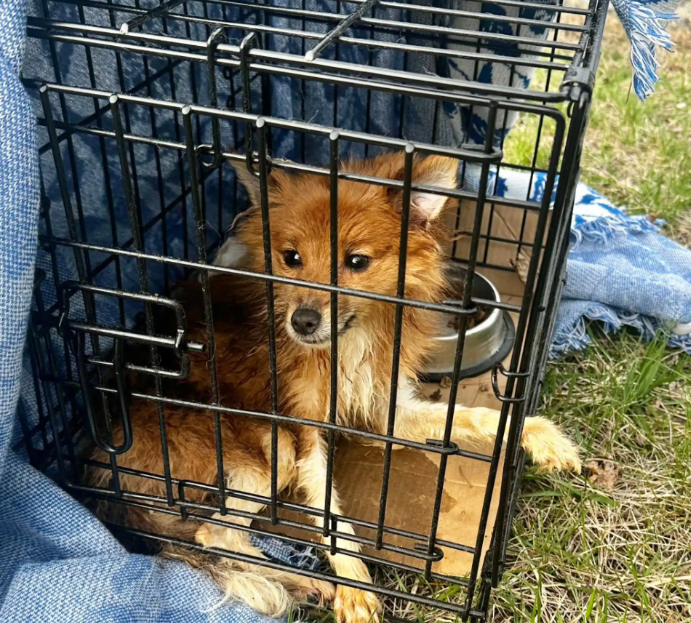
When rescuers reached him, they didn’t see a puppy in distress.
They saw a body that had been pushed past its limit.
He was rushed immediately into emergency care, where veterinarians began stabilizing him around the clock.
One of the most alarming discoveries came quickly — his body was so severely impacted by trauma and starvation that his systems were wildly out of balance, requiring intensive monitoring just to keep him stable.
From that moment forward, survival became a medical operation.
Not a hope.
A battle.
The care team moved fast.
Warmth. Fluids. Carefully controlled feeding. Constant observation.
Everything had to be measured precisely — because when a body has been starved this severely, even normal food can become dangerous if introduced too quickly.
Every hour mattered.
Every adjustment mattered.
And every small response from his body was a sign they were still in the fight.
While his physical condition was being stabilized, another effort was underway: identifying what had happened.
Authorities confirmed the puppy had been abandoned in the crate and left along the roadside, triggering an active investigation into who was responsible.
The shelter made one thing clear — this wasn’t just neglect.
It was cruelty.
And they were determined to see accountability.
But amid all the pain of the discovery, something unexpected began to emerge.
Firefox was still here.
Still breathing.
Still fighting.
Even in his weakest state, there were signs that his body hadn’t fully given up. A flicker of response. A small shift in energy.
Tiny moments that suggested that underneath everything he had endured, there was still a spark left to protect.
And that spark mattered.
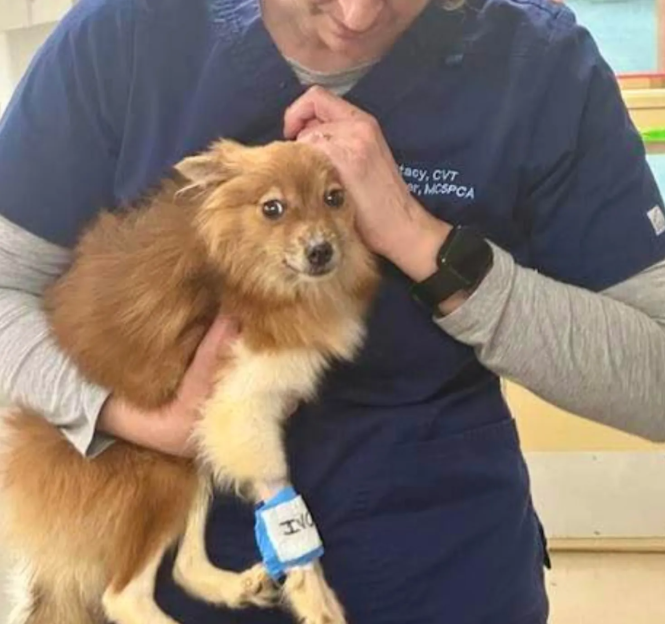
The Monmouth County SPCA took him into long-term care, beginning a recovery process that will take time — not just physically, but emotionally as well. Rehabilitation includes slow refeeding, physical therapy, and round-the-clock medical support to rebuild what was lost.
There are no quick fixes in cases like this.
Only patience.
Only consistency.
Only hope measured in small increments.
And yet, that hope is real.
Because dogs like Firefox don’t recover all at once.
They recover in moments.
A stronger breath.
A steadier stand.
A glance that lasts a little longer than the last one.
What remains most powerful about this story isn’t just how close he came to death.
It’s that he didn’t reach it.
Not yet.
And now, for the first time in what may have been the darkest stretch of his short life, Firefox has something he didn’t have before:
Time.
Care.
And a chance to become more than what he was left as.