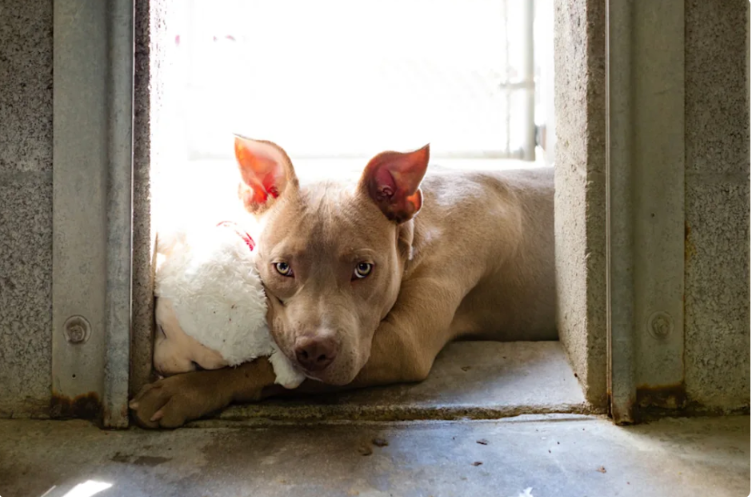
No one noticed him at first.
Not because he wasn’t there—but because he had learned how to disappear.
Inside an abandoned warehouse, surrounded by dust, silence, and the hollow echoes of a place long forgotten, a stray dog had made a life out of survival.
No soft bed. No steady meals. No human voice calling his name.
Just space.
Empty, cold, and unforgiving.
That’s where he stayed.
Day after day.
In places like that, time doesn’t move the same way. There are no routines, no markers, no comfort. Just waiting—without knowing what you’re waiting for.
For this dog, survival meant staying hidden. It meant avoiding danger, conserving energy, and existing quietly enough not to draw attention.
Because attention, in the past, may not have always meant something good.
So he kept to himself.
Until someone finally saw him.
Rescuers learned about a dog living inside the abandoned structure and decided to investigate. These calls don’t always lead to clear outcomes.
Sometimes the animal is gone. Sometimes they won’t come close. Sometimes the damage—physical or emotional—is harder than expected.
But they went anyway.
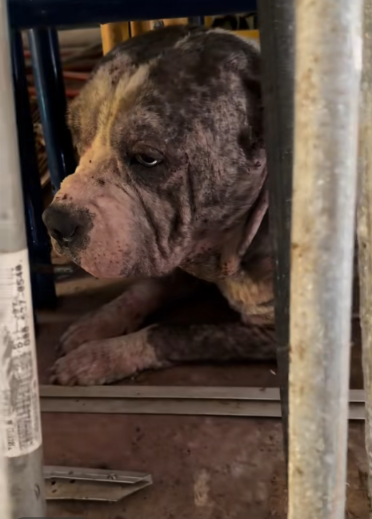
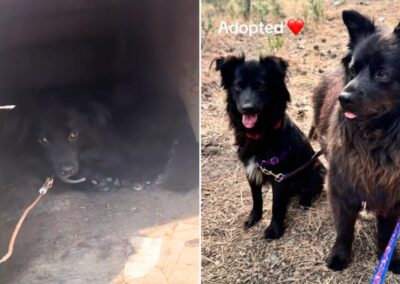
When they arrived, they found exactly what had been described.
A dog.
Thin, cautious, and deeply unsure.
He didn’t rush forward. He didn’t bark. He didn’t show excitement or relief.
He just watched.
That kind of stillness says a lot. It’s not calm—it’s guarded. A learned behavior shaped by uncertainty. When a dog has spent enough time alone, especially in a place like that, trust doesn’t come easily.
It has to be rebuilt.
Slowly.
Carefully.
The rescuers didn’t push. They didn’t force interaction. They gave him space, allowing him to observe, to process, to decide whether these humans were different from whatever he had known before.
And eventually, something shifted.
It wasn’t dramatic.
No sudden sprint forward. No instant connection.
Just a small step.
Then another.
A quiet decision to move closer instead of further away.
That moment matters more than it looks.
Because for a dog like him, approaching a human isn’t just movement—it’s risk.
And he took it.
From there, the process moved forward with patience. He was guided out of the warehouse, away from the only environment he had known for who knows how long.
Leaving that space wasn’t just physical—it was emotional. Even difficult places can feel familiar when they’re all you have.
But outside, something new waited.
Safety.
Food.
Care.
At first, he remained cautious. That didn’t change overnight. Dogs coming from isolation don’t suddenly become affectionate or relaxed.
They observe. They test. They learn whether this new situation is stable or temporary.
But the consistency made a difference.
Meals arrived regularly.
Voices stayed calm.
Hands were gentle.
And slowly, the tension in his body began to fade.
His posture softened. His eyes became more engaged. He started responding—not just reacting. Small signs, but meaningful ones.
The kind that show a dog is beginning to understand that survival isn’t the only option anymore.
There’s something powerful about watching that shift.
Because it’s not just physical recovery.
It’s emotional.
It’s the moment a dog realizes they don’t have to stay hidden anymore.
That they can exist out in the open—without fear attached to every movement.
Over time, he continued to change.
The dog who once blended into the shadows of an empty warehouse started to stand out.
Not because he became something new—but because he no longer had to shrink himself to survive.
He became visible.
And with that visibility came something else.
Possibility.
A future that didn’t involve empty rooms or silent nights.
A life that included connection.
Care.
Maybe even love.
Stories like this don’t rely on dramatic rescues or instant transformations. What makes them resonate is the quiet progression—the slow rebuilding of trust, the steady shift from fear to stability.
Because for dogs like him, the biggest change isn’t just leaving a bad place.
It’s learning that a better one can exist.
And in the end, that abandoned warehouse became just a part of his story.
Not the place where it ended—
But the place he finally left behind.