Most people preparing to move abroad think about paperwork, packing, and logistics.
Emily Gardner had all of that—but there was one decision she refused to compromise on.
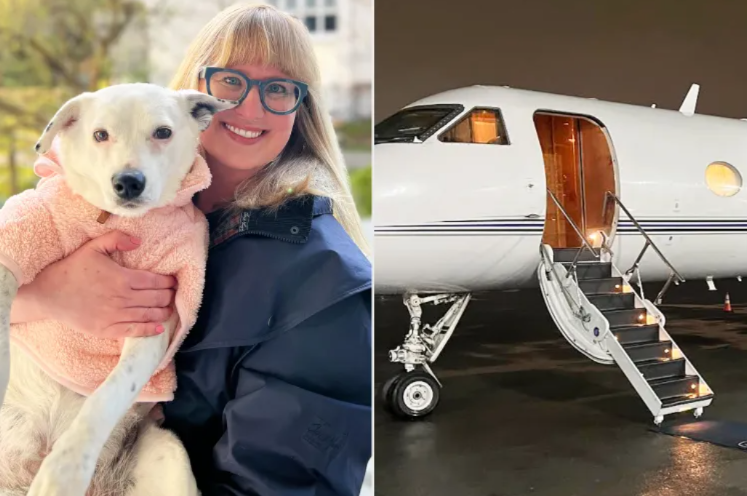
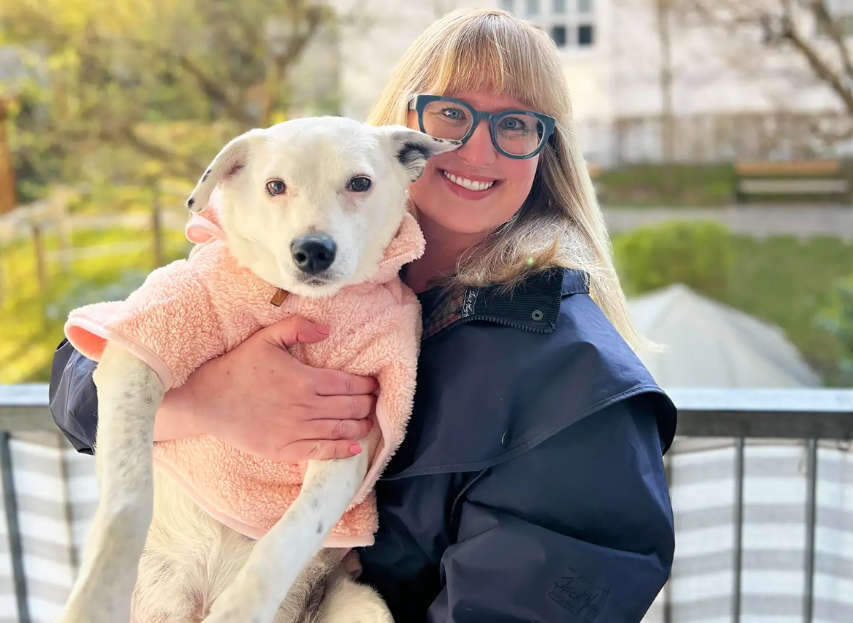
Her 14-year-old rescue dog, Luna, was coming with her.
No matter what it took.
The move itself was already life-altering. Emily and her husband were relocating from the United States to Germany for his job, a transition that involved long-distance planning, emotional strain, and the dismantling of an entire life built at home.
But through all of it, Luna remained the constant.
Adopted when she was just seven months old, she had spent nearly her entire life by Emily’s side.
Now, at 14, she was a senior dog—slower, more fragile, and far more sensitive to stress and change.
Which made the next part impossible to ignore.
Most commercial airlines required pets to fly in cargo for long-haul international travel.
For a young, healthy dog, that can already be stressful. For a senior dog like Luna, the risks felt far too high.
Emily couldn’t accept that.
Putting her in the cargo hold for a transatlantic flight wasn’t just uncomfortable—it felt unsafe.
So she made a decision that stunned even herself.
She wouldn’t put Luna in cargo.
She would find another way.
What followed was months of preparation, sacrifice, and problem-solving that reshaped their entire move.
The couple sold belongings, adjusted budgets, and explored alternatives until they found one option that allowed Luna to stay with her owner throughout the journey: a private, dog-friendly charter flight.
It wasn’t simple. And it wasn’t cheap.
But it meant one thing that mattered more than anything else.
Luna wouldn’t be alone.
On the day of the flight, everything felt different.
Instead of separation at check-in, there was closeness.
Instead of uncertainty about what was happening below the plane, there was calm—Luna resting comfortably near Emily, steady and relaxed, as if she understood that this time, she was not being left behind.
For Emily, the emotional weight of months of stress finally lifted in that moment.
The decision wasn’t just about travel anymore.
It was about loyalty.
About refusing to let distance redefine family.
The flight itself passed without incident, but what mattered most wasn’t the logistics—it was the presence.
Luna remained close, calm under medication and comforted simply by being where she always felt safest: beside her person.
When they landed in Germany, something surprising happened.
Luna adapted quickly.
After a few days of rest and recovery from jet lag, she settled into their new apartment as if she had always been there.
New surroundings didn’t seem to unsettle her in the way many expected. Instead, she returned to her familiar routines—sleeping, walking, following Emily from room to room.
And slowly, life began again in a different country.
Now based in Munich, Emily’s days look very different from before.
Work has slowed, routines have shifted, and life has become quieter. But one thing remains unchanged: Luna is always near.
Long walks through new neighborhoods.
Slow mornings at home.
Small, ordinary moments that now carry extra meaning.
Because for Emily, the decision to keep Luna by her side wasn’t just about avoiding cargo travel.
It was about what “home” actually means.
Not a place on a map.
Not a house or a city.
But being together—no matter how far you go.
And for Luna, after 14 years of life, the message is simple in its own way:
She didn’t get left behind.
She got brought along.
Every step of the way.