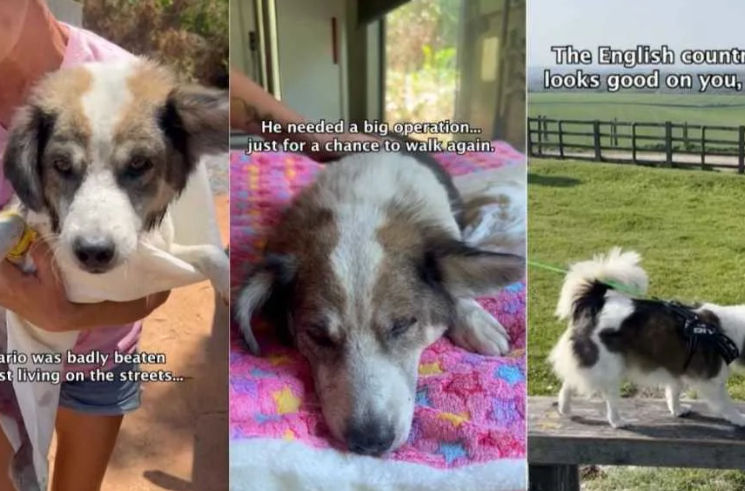
At first, she couldn’t walk.
Not properly.
Not at all in the way a healthy dog should.
Her body had been through something severe—an injury or condition so painful and limiting that even basic movement became a struggle.
For a dog, that changes everything. Mobility isn’t just freedom—it’s safety, independence, life itself.
And she had lost it.
But she didn’t stay there.
Because someone stepped in.
Rescue teams found her in a condition that required urgent medical attention.
She wasn’t just weak—she was unable to use her back legs properly, her movements restricted and uncertain.
It was the kind of case that doesn’t have easy answers, only a long road of patience and care.
What came next wasn’t quick recovery or instant transformation.
It was work.
Day after day of rehabilitation. Gentle exercises. Assisted movement.
Supportive care designed not just to heal the body, but to rebuild trust in it.
At first, progress was barely visible.
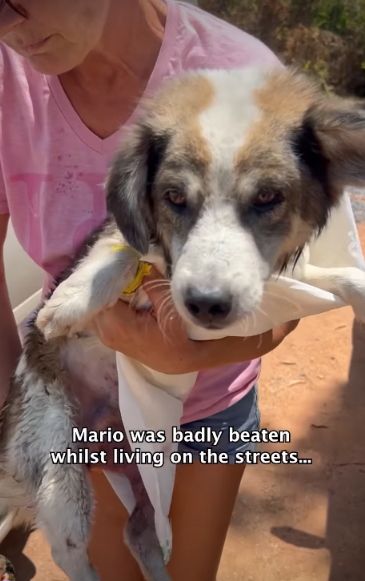
Small shifts. Slight adjustments. Moments where she would try to engage her legs again, only to fall short.
For many animals in this condition, recovery isn’t linear—it’s incremental, uneven, and emotionally demanding for everyone involved.
But something important was happening underneath all of it.
She kept trying.
And that matters more than anything.
Over time, the smallest signs began to appear. A brief stand. A supported step. Then another.
The kind of progress that doesn’t look impressive from the outside—but means everything when you’ve been unable to do it at all.
The people caring for her didn’t rush the process. They couldn’t.
Instead, they built consistency around her recovery. Repetition. Encouragement. Stability.
The kind of environment where a body can slowly remember what it was once capable of doing.
And then, something shifted.
She started to walk.
Not perfectly. Not confidently at first. But unmistakably—movement that came from her own effort, not just assistance.
Those first real steps marked a turning point.
Because once a dog begins to move again on her own, everything changes: confidence, behavior, emotional state. Pain begins to give way to possibility.
Rehabilitation continued, and so did improvement. With time, her movements became more coordinated, more stable.
What once required full support gradually turned into partial assistance—and then, occasional independence.
The transformation wasn’t just physical.
It was emotional.
Dogs recovering from trauma like this often show subtle but powerful changes: more engagement with people, increased curiosity, and a return of personality traits that may have been suppressed by pain or fear.
She began to show those signs too.
Interest in her surroundings.
A calmer posture.
A willingness to participate in her own recovery rather than resist it.
And that’s where stories like this become more than medical recoveries.
They become reminders.
That healing isn’t always dramatic.
Sometimes it’s slow enough that you almost miss it—until one day you realize the dog who couldn’t walk… is now standing beside you without help.
What makes her journey especially powerful is not just that she learned to walk again.
It’s that she had to rebuild trust in her own body to do it.
Every step was earned twice—once physically, and once emotionally.
And now, instead of being defined by what she lost, she’s defined by what she regained.
Movement.
Strength.
Possibility.
Because sometimes recovery doesn’t look like a miracle.
It looks like repetition.
It looks like patience.
And it looks like a dog, once unable to take a single step…
deciding, again and again, that she will try one more time.