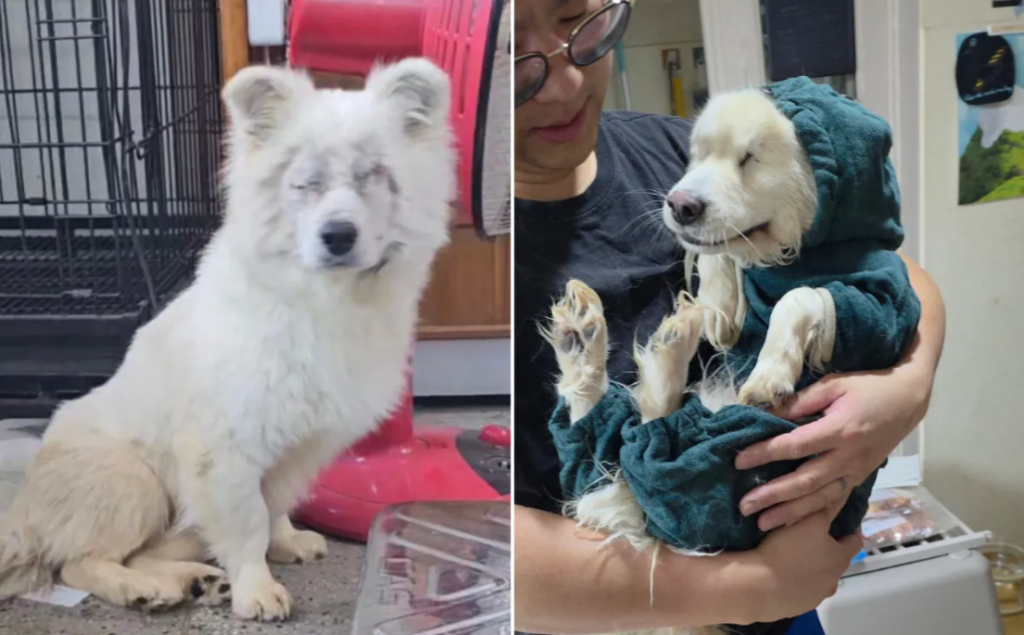
He survived something most dogs never come back from.
A car accident that changed everything in a single moment.
The impact left him severely injured. His body was broken in ways that required urgent medical care, and the damage to his eyes was irreversible.
Eventually, both eyes had to be removed—leaving him completely blind.
But survival was only the first part of his story.
The second part is harder.
Finding someone willing to see him beyond what he lost.
Before the accident, he was a stray—just another dog trying to survive on the streets.
After the accident, he became something else in the eyes of many: a dog with extra needs, a difficult case, a long-term responsibility.
And that label followed him.
Even after rescue teams stepped in and gave him the medical care he needed, including surgery and recovery support, his future remained uncertain.
Physically, he healed as much as he could.
Emotionally, he adapted in his own way.
Blind dogs don’t experience the world in darkness the way humans imagine it.
They rebuild their sense of safety using sound, scent, memory, and touch. They learn environments instead of seeing them.
They map trust instead of space.
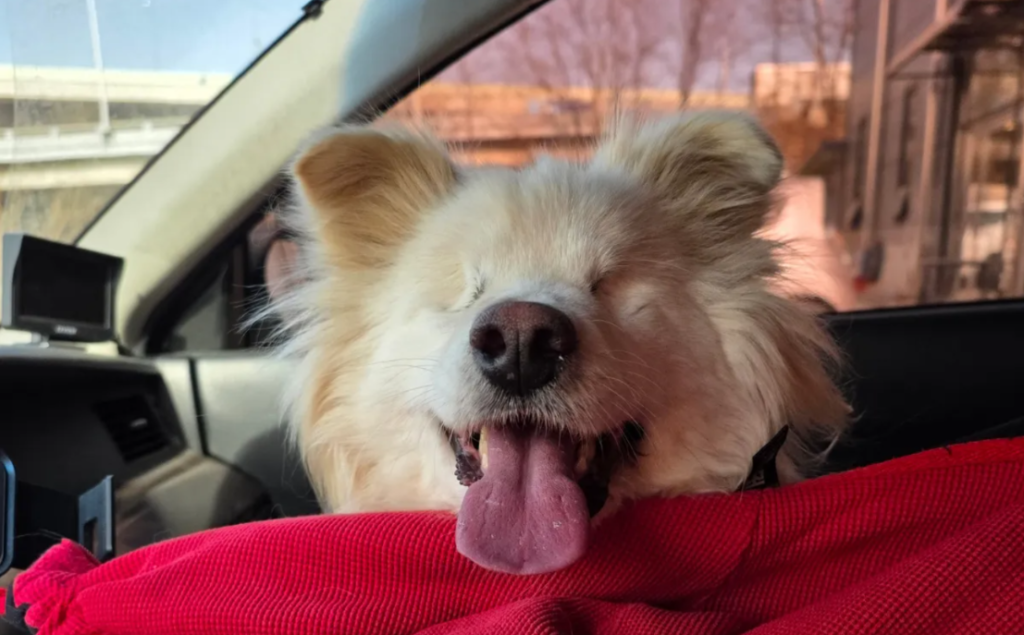
But none of that removes the challenges.
New places are confusing. Sudden noises are disorienting. And unfamiliar people can feel overwhelming at first.
So even in a shelter environment designed to help him, he struggled to settle.
Not because he was difficult.
But because his world had changed too completely, too quickly.
And still—through all of it—he remained gentle.
That’s what makes his situation so heartbreaking.
Despite everything he has endured, he has not closed off. He has not become defensive or withdrawn in the way many would expect.
Instead, he still shows curiosity. Still responds to kindness. Still leans toward connection when it’s offered slowly and safely.
But in a shelter full of noise, movement, and constant change, those moments are rare.
What he needs now isn’t just care.
It’s consistency.
A home that understands blindness isn’t absence—it’s adaptation.
A person willing to build routines he can learn and trust. A space where furniture doesn’t shift unpredictably.
A life where voices matter more than appearances.
Rescue teams working with him describe a dog who is ready in every way that matters emotionally—just waiting for the environment that allows him to thrive physically and mentally.
And that’s where the story shifts from tragedy to possibility.
Because dogs like him often surprise people once they’re given the chance.
Blind dogs learn faster than expected. They memorize layouts. They navigate using sound cues.
They form deep bonds with caregivers because trust becomes their primary guide.
What looks like limitation at first becomes a different kind of intelligence.
A different kind of awareness.
But none of that matters without someone willing to take the first step.
The decision to adopt a blind dog isn’t about perfection.
It’s about perspective.
Seeing that what was lost doesn’t define what remains.
Right now, he is still waiting.
Not in despair.
Not in defeat.
But in that quiet, steady way dogs wait when they don’t understand timelines—only hope.
He doesn’t know how many people have read his story.
He doesn’t know how many have paused, considered, and moved on.
He only knows each day as it comes.
And each day, he remains the same:
A dog who has already survived the worst thing that ever happened to him…
still believing, in the only way he knows how,
that someone will finally come and take a chance on what’s left.