For most rescue dogs, toys aren’t just toys.
They’re comfort objects. Anchors. Something to hold onto when everything else in life has been uncertain or lost.
So when one rescued dog was finally given something unexpected—a plush toy made to look exactly like him—it didn’t just feel like a cute moment.
It felt personal.
The dog, Archie, had already made it into a loving home after a difficult start in life.
Like many rescue dogs adjusting to safety after instability, he still leaned on familiar comforts—especially soft toys that helped him feel grounded when the world around him got overwhelming.
But this gift was different.
It wasn’t just a toy.
It was him.
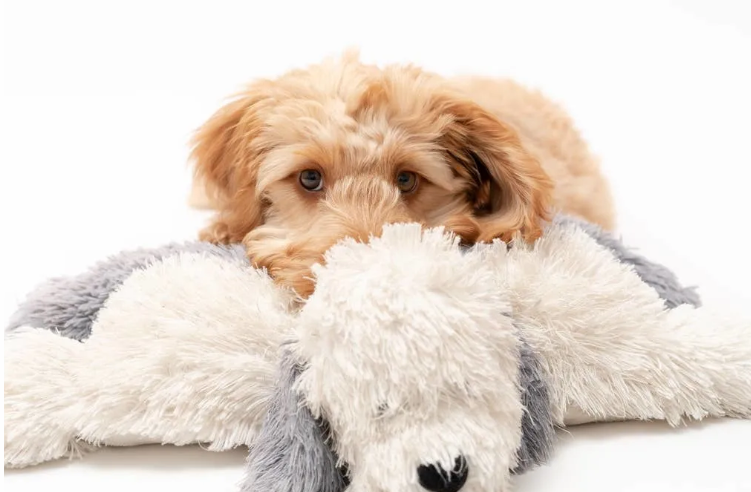
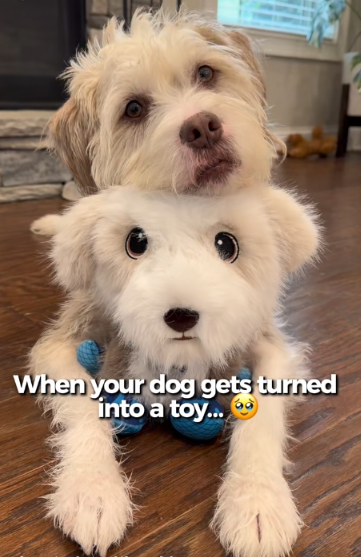
A lookalike plushie designed to mirror his own face and coloring was presented to him as a companion—almost like a miniature version of himself sitting there, waiting to be acknowledged.
And his reaction said everything.
At first, there was hesitation.
A pause.
That classic “what exactly is this?” moment dogs often show when confronted with something unfamiliar but intriguing.
Then curiosity took over. He sniffed, leaned in, and began to engage with the toy in a way that quickly shifted from uncertainty to comfort.
Because something about it made sense to him.
It wasn’t just fabric and stuffing.
It was familiarity in physical form.
For many rescue dogs, objects like stuffed animals become emotional bridges—helping them cope with stress, transition, and the lingering uncertainty that can come even after adoption.
They carry scent, softness, and repetition, all of which contribute to a sense of safety and continuity.
In Archie’s case, the lookalike design added something even more interesting: recognition.
Dogs don’t understand “self-image” the way humans do, but they do respond strongly to familiar shapes, smells, and emotional associations.
When something mirrors their world closely enough, it can register as safe—even meaningful.
That’s why he didn’t reject it.
He accepted it.
And eventually, he settled with it like it had always belonged there.
His family noticed the shift immediately.
What started as a novelty item became part of his comfort routine—something he could rest beside, carry around, or simply keep nearby when he wanted reassurance.
Not every dog bonds with toys this way. Some ignore them entirely. Others destroy them within hours.
But for dogs like Archie, especially those with sensitive temperaments or past instability, a consistent comfort object can become surprisingly important in emotional regulation.
What makes this story resonate isn’t just the novelty of a “mini-me” plush.
It’s what it represents.
A dog who once had uncertainty now has something stable enough to recognize himself in.
Not literally—but emotionally.
A small object that carries the same message over and over again: you are here, you are safe, you belong.
And in a quiet way, Archie seemed to understand that.
He didn’t treat it as a stranger.
He treated it as part of his space.
Something to return to.
Something to trust.
Because sometimes healing doesn’t show up as big breakthroughs or dramatic changes.
Sometimes it shows up as a dog lying down next to a toy that looks like him…
and finally, for the first time in a long time, resting without hesitation.