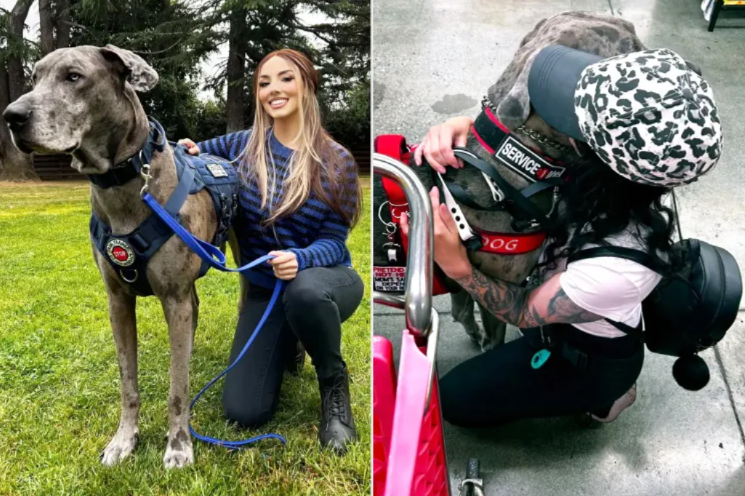
For Alexa, even ordinary moments can carry risk.
Standing. Walking. Climbing stairs.
Things most people do without thinking are, for her, potential danger points.
The 35-year-old Bay Area administrative assistant has been living with Postural Orthostatic Tachycardia Syndrome (POTS) for eight years—a chronic condition that affects heart rate and blood pressure regulation, often triggering dizziness, fatigue, and sudden drops in stability when changing posture.
It changed her life in ways that weren’t immediately visible—but were deeply felt.
“Basic tasks that most people don’t think twice about… suddenly became very difficult,” she explained.
Over the years, she’s gone through extensive treatment, including physical therapy, occupational therapy, and vestibular rehab.
Her journey has also included serious complications, such as a blood clot in her internal jugular vein linked to a treatment port.
But she hasn’t faced it alone.
By her side is Otti, a 5-year-old Great Dane—and her second service dog.
Otti is not just companionship. He is medical support in real time.
He’s trained to detect sudden changes in Alexa’s condition, including spikes in heart rate and drops in oxygen levels—often before she feels them herself.
When those changes happen, he doesn’t wait. He responds immediately.
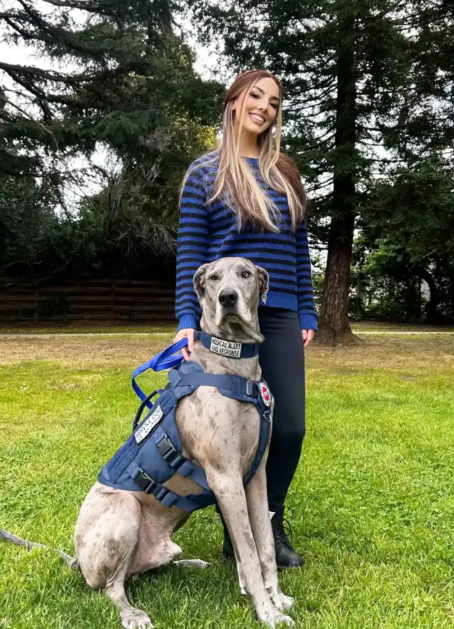
He alerts her. Guides her to safety. And performs deep pressure therapy, using his large frame to help stabilize her nervous system during episodes.
His size isn’t incidental—it’s part of his role.
As a Great Dane, Otti provides physical grounding that smaller dogs simply can’t, especially when Alexa needs balance assistance or vestibular support during disorientation.
He also helps with practical tasks: retrieving items, guiding her during confusion, and even leading her out of environments when she becomes overwhelmed or at risk.
But one recent moment showed just how critical that training can be.
After a routine cardiology appointment, Alexa and Otti found themselves at the top of a long flight of stairs.
It seemed like a normal transition—until Otti suddenly alerted.
Something was wrong.
Alexa’s heart rate was spiking. Her oxygen levels had dropped into the 80s.
She tried to continue forward anyway, moving toward the stairs as if she could push through it.
But Otti stopped her.
Completely.
“He completely refused to let me go down,” she recalled.
He positioned himself in front of her, blocking the path.
Then made a decision that surprised even Alexa.
Instead of allowing her to descend the stairs—a route he normally avoids due to his own fear—Otti turned around and guided her toward the elevator.
It was a deliberate choice.
A trained response overriding instinct.
Because in that moment, he wasn’t thinking about comfort.
He was thinking about safety.
“He knew that if I continued to walk down the stairs, I could faint and get seriously injured,” Alexa said.
“He chose to face it because he knew it was the only safe way to get me downstairs.”
The moment was captured on video, originally recorded to share with her trainer and doctors. But once posted online, it took on a life of its own.
Millions of people watched as a dog quietly refused to let his handler take a dangerous step.
And millions more responded with emotion—shock, admiration, and a deeper awareness of what service dogs actually do.
Not just companionship.
Not just obedience.
But intervention at the exact moment it matters most.
For Alexa, the viral attention wasn’t expected.
“I honestly never expected the video to reach so many people,” she said. “But what surprised me the most was how emotional people got over it.”
Because at its core, the moment wasn’t dramatic in appearance.
No chaos.
No noise.
Just a dog who knew something was wrong…
and chose the only safe path forward—even if it meant facing what he feared himself.
And in doing so, he did exactly what service dogs are trained to do.
He didn’t hesitate.
He protected her.