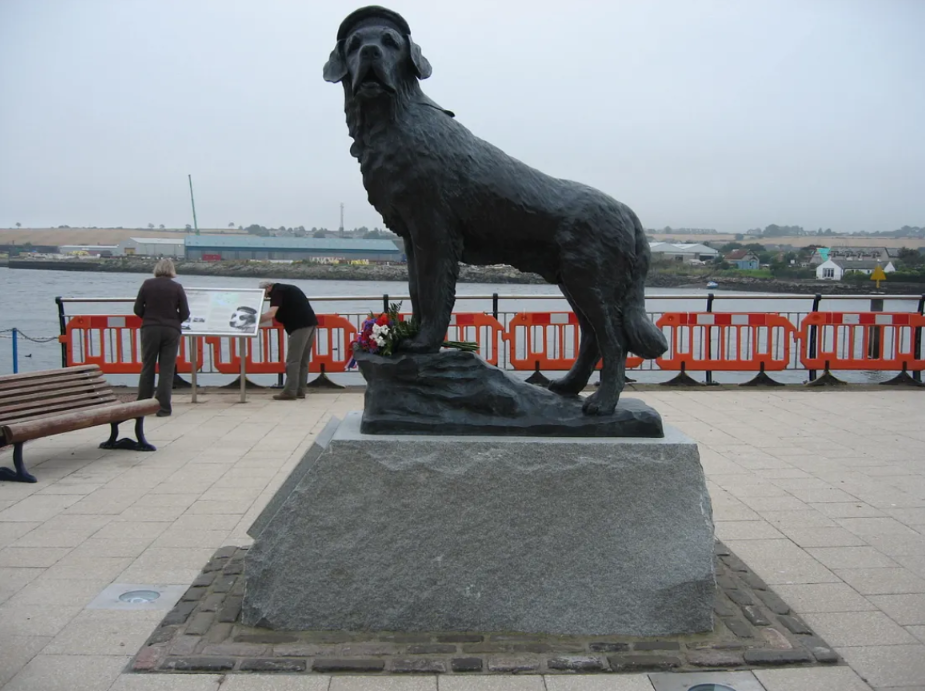
In the middle of World War II, when fear and uncertainty spread across Europe, there was an unlikely figure offering something different aboard a Norwegian naval vessel.
Not a soldier.
Not an officer.
But a dog.
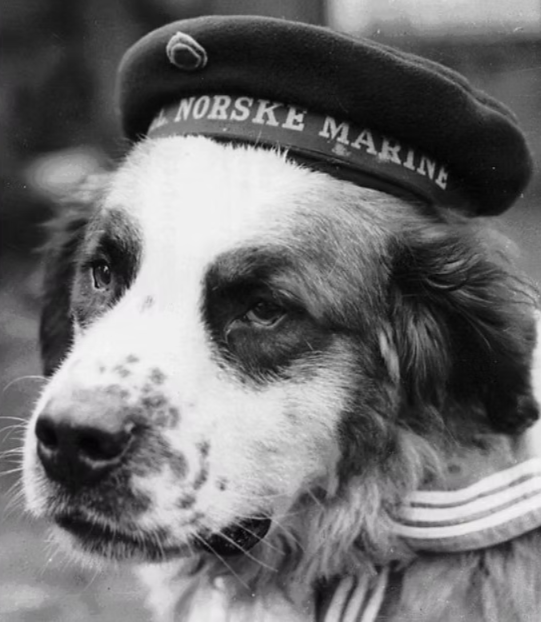
His name was Bamse, a Saint Bernard whose presence would become one of the most enduring symbols of courage, loyalty, and morale for the Free Norwegian Forces during the war.
And while history is filled with human heroes, Bamse’s story stands out for something simpler:
He didn’t fight the war.
He held people together through it.
Before he ever set foot in Scotland, Bamse lived a quieter life in Norway with Captain Erling Hafto’s family.
Even then, he showed a deeply calm and protective nature, famously staying by the side of the family’s ill young daughter until she recovered—refusing to leave her room except for trusted adults.
It was an early glimpse of what kind of dog he would become.
When war broke out, everything changed.
Bamse followed Captain Hafto into naval service and officially became part of the crew aboard the minesweeper Thorodd in 1940.
At first, he was simply the ship’s mascot.
But that title quickly became too small for what he actually did.
After Norway fell to German forces, the Thorodd escaped to the United Kingdom, operating out of Scotland for the remainder of the war.
And it was there—in places like Montrose and Dundee—that Bamse’s legend truly took shape.
Life at sea and in wartime ports was stressful, unpredictable, and often tense. Crews needed something to hold onto beyond duty and survival.
Bamse became that anchor.
He wasn’t just present on the ship—he was part of its rhythm.
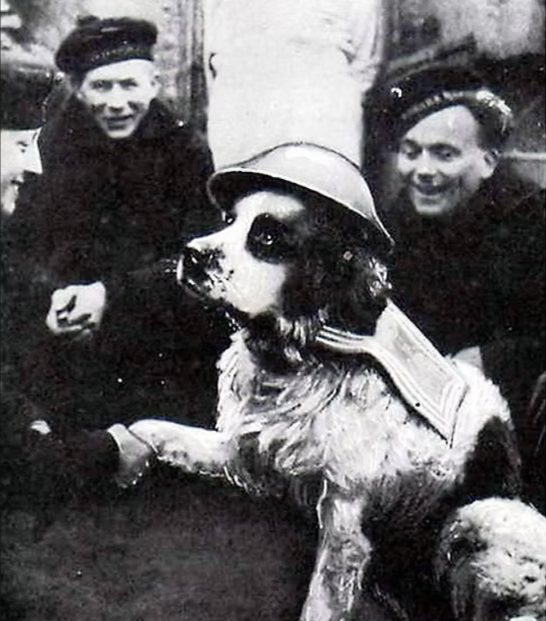
He would stand on deck during patrols, wearing a specially made helmet, as if he understood his role in the crew’s morale.
But his real impact wasn’t ceremonial.
It was personal.
Bamse had a remarkable ability to sense conflict and intervene in his own way. If sailors argued, he would step between them, placing his paws on their shoulders and physically breaking the tension until calm returned.
He also comforted frightened or distressed crew members, often choosing the men who needed him most without being called.
And then there were the moments that made him famous among locals.
When shore leave ended and sailors lingered too long in pubs, Bamse would go looking for them.
If necessary, he would board public buses alone—traveling through town with his collar bus pass—to round up his crew and bring them back to duty on time.
To the people of Scotland, he wasn’t just a dog on a ship.
He was a character woven into daily life.
But beneath the charm, there were moments of real heroism too.
Bamse is credited in accounts with saving crew members during violent incidents—once intervening during an attack and another time helping pull a sailor from the water after he fell overboard.
These weren’t symbolic acts.
They were life-saving ones.
Over time, he became more than a ship’s mascot.
He became a symbol of something larger: resilience during war, unity among allies, and the quiet strength that doesn’t always come from leadership—but from presence.
When Bamse died in 1944, the reaction was immediate and deeply emotional.
He was given a full military-style funeral, attended by Norwegian sailors, Allied personnel, and local civilians who had come to know him during the war years.
For many, it felt like losing a comrade.
Even after his death, his legacy didn’t fade.
Memorials were built.
Stories were shared.
And decades later, statues were erected in his honor, preserving his place in wartime history.
Because Bamse’s story isn’t really about a dog performing tricks or earning titles.
It’s about something far more enduring.
A presence that calmed fear.
A companion that bridged cultures during war.
A living reminder that loyalty doesn’t need language to be understood.
And in the end, that’s what made him unforgettable.
Not that he stood in battle.
But that in the middle of one of history’s darkest times…
he made people feel a little less alone.