In the quiet hours of a day that began like any other, a dog found himself in a situation most of us can hardly imagine.
He wasn’t lost.
He wasn’t hiding.
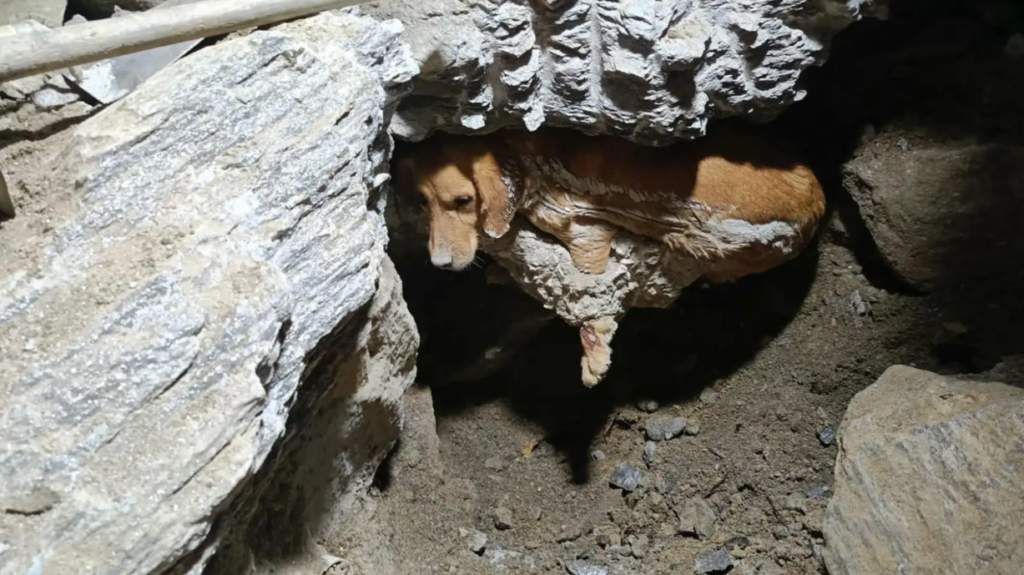
He was trapped — stuck fast in wet concrete and unable to move, unable to free himself without help.
And for hours, he barked.
Not just once, not just out of habit — he barked loudly, consistently, persistently… until someone finally heard him.
When rescuers arrived, what they discovered was both heartbreaking and miraculous.
The dog had been caught in freshly poured cement, the sticky mixture dried around him like a cage. His legs were encased. His mobility gone. But still — he barked.
It wasn’t just noise.
It was a signal. A plea. A call for help that refused to go silent.
Rescuers who responded to the distress call later described the scene as grim, explaining that the concrete had hardened all around the dog’s body, pinning him in place.
Yet despite the pain, despite the discomfort, he had kept barking — long enough for someone to finally respond.
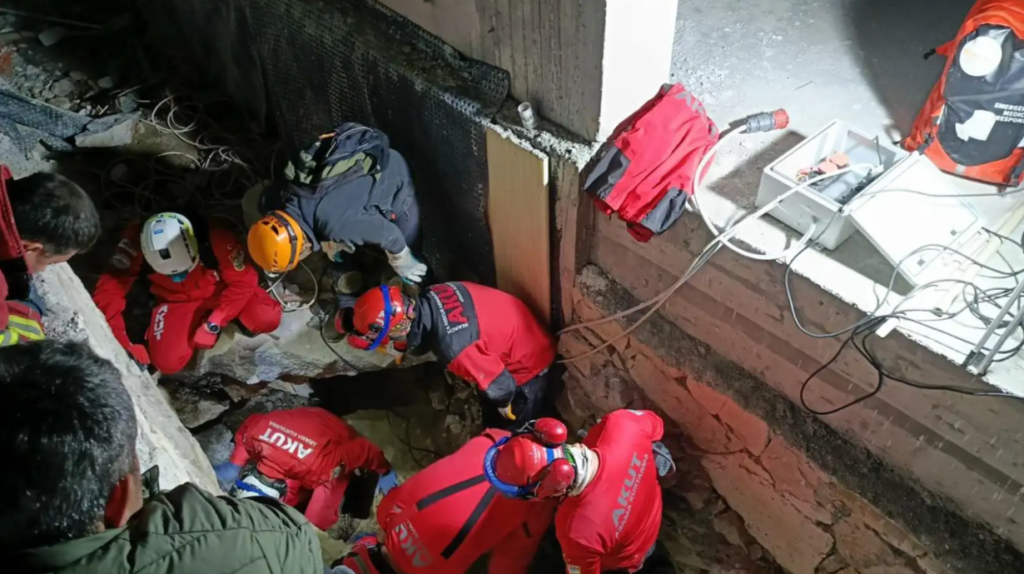
The work to free him took time, care, and a lot of patience. Removing concrete without hurting a trapped animal requires precision — you can’t just pull or yank.
Rescuers had to chip away carefully, controlling each movement so they didn’t injure him further. Each tap of the tool was a negotiation between freeing his body and protecting his safety. [theDodo]
Slowly, piece by piece, the concrete shell began to crack. The harder it was to break through, the more determined the rescuers became — because every bit of progress meant hope for the dog inside.
And then finally — he was free.
But freedom wasn’t instant comfort.
His legs were sore. His body exhausted. His spirit shaken.
Yet there was something remarkable beneath it all: even after hours of barking while trapped, even after physical strain and fear, his first instinct wasn’t to collapse or retreat.
It was to wag.
That tail — weak at first — then stronger — showed something powerful: he wasn’t done. He still trusted people. He still hoped for love. He still believed someone was coming.
That small, wagging movement was more than a reaction. It was a message:
“I’m okay now.”
Medical evaluation came next.
Vets cleaned his wounds, treated his bruised muscles, checked for long‑term damage, and gave him the chance to rest without fear.
The pain was real. The exhaustion was real. But the recovery — physical and emotional — was just beginning.
Staff described the moment after his rescue with awe: the dog looked at his rescuers not with anger or fear, but with acceptance.
He didn’t flinch away. He didn’t growl. He simply breathed and took in the kindness finally surrounding him.
That reaction is a reminder of something deep about dogs: even after trauma, even after struggle, they can still choose connection.
News of his rescue spread quickly online, not just because of the dramatic nature of the situation, but because it encapsulated something universal — resilience, hope, and the idea that perseverance pays off.
People pointed to that barking, over and over. They said it wasn’t just sound — it was logic. It was survival instinct. It was a strategy that saved his life.
If he hadn’t barked… if he had stayed silent… who knows how long he might’ve remained trapped.
Today, the dog is recovering, resting, and reconnecting with the simple joys he lost while stuck in concrete:
– gentle pats
– soft bedding
– food that arrives on time
– and the freedom to move his legs again
Each step he takes now is a contrast to the one he couldn’t make before.
This isn’t just a rescue story.
It’s a tribute to persistence.
To every bark that refused to stop.
To the idea that sometimes, the only thing standing between a trapped animal and safety is a voice that refuses to be quiet.
And in this case?
That voice saved a life.