It started with a moment that could have ended everything.
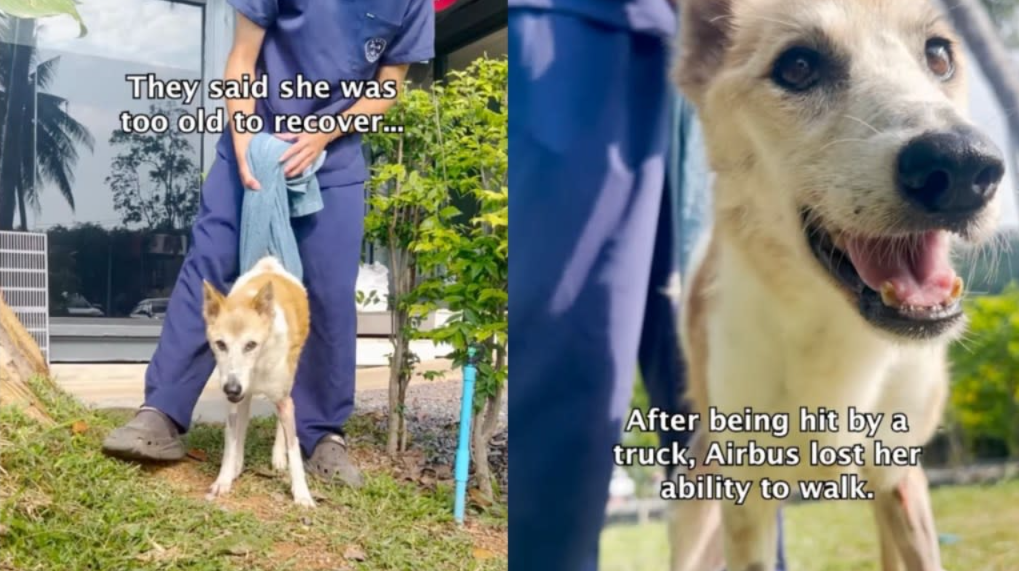
A senior rescue dog, already carrying the weight of age and past hardship, was found in a condition that made survival uncertain.
Weak, injured, and exhausted, she had every reason to shut down — physically and emotionally.
But she didn’t.
Instead, she began something remarkable: recovery.
The dog, featured by an animal rescue community known for documenting rehabilitation journeys, was shown in a recent update slowly learning to move again after a serious setback.
Her condition required patience, medical care, and constant monitoring — the kind of recovery that doesn’t happen quickly, or easily.
And yet, progress came.
Not in leaps.
In steps.
At first, even basic movement was a challenge. Her body, weakened by age and injury, needed time to adjust to stability again.
Caregivers focused on comfort, hydration, and gentle encouragement — rebuilding trust in both her body and her surroundings.
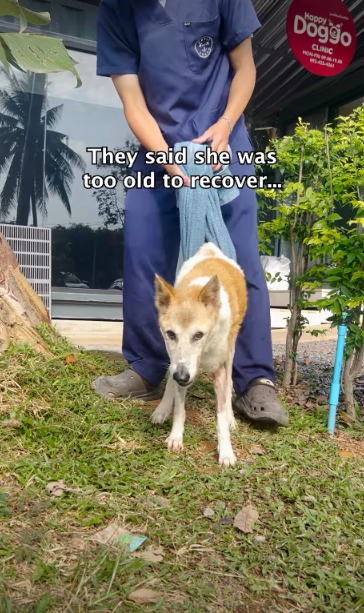
For senior dogs, recovery isn’t just physical. It’s psychological too.
They have to relearn safety.
Relearn movement.
Relearn that effort won’t always lead to pain.
But slowly, something shifted.
The dog began to respond more consistently to care. Small changes appeared — steadier posture, more alert eyes, and moments where she seemed to engage with her environment instead of retreating from it.
These are the quiet victories that matter most in rehabilitation.
Not dramatic transformations.
But signs that the fight is still there.
A key part of her progress came through structured, gentle rehabilitation — short movement sessions, supportive handling, and consistent routines that helped rebuild strength without overwhelming her system.
Each day added a little more stability.
Each step added a little more confidence.
And each moment of progress reinforced something important: she wasn’t done yet.
What makes stories like this resonate so deeply is not just the recovery itself, but what it represents.
Senior dogs are often underestimated when they face health challenges.
Age can make recovery slower, more complex, and emotionally heavier for both the animal and the caregivers.
But cases like this prove something important:
Age is not the end of effort.
It just changes the pace.
Over time, her transformation became visible in subtle but powerful ways. She began to move with more intention. Rest with more ease. And engage with her surroundings with less hesitation.
Where there was once only survival, there was now adaptation.
And where there was once uncertainty, there was now progress.
Her caregivers continue to monitor her closely, knowing recovery is not linear. There are good days and harder days.
Moments of strength followed by moments of fatigue.
But the direction is clear.
Forward.
And that’s what makes this story stand out.
Not because a miracle happened overnight.
But because nothing about it was instant.
It was slow. Intentional. Earned.
A reminder that healing — especially for senior dogs — is not about speed.
It’s about persistence.
In the end, this is more than a recovery story.
It’s a quiet declaration that even when the odds feel stacked, even when the body feels tired, and even when the world expects less…
A dog can still choose to try again.
One step at a time.