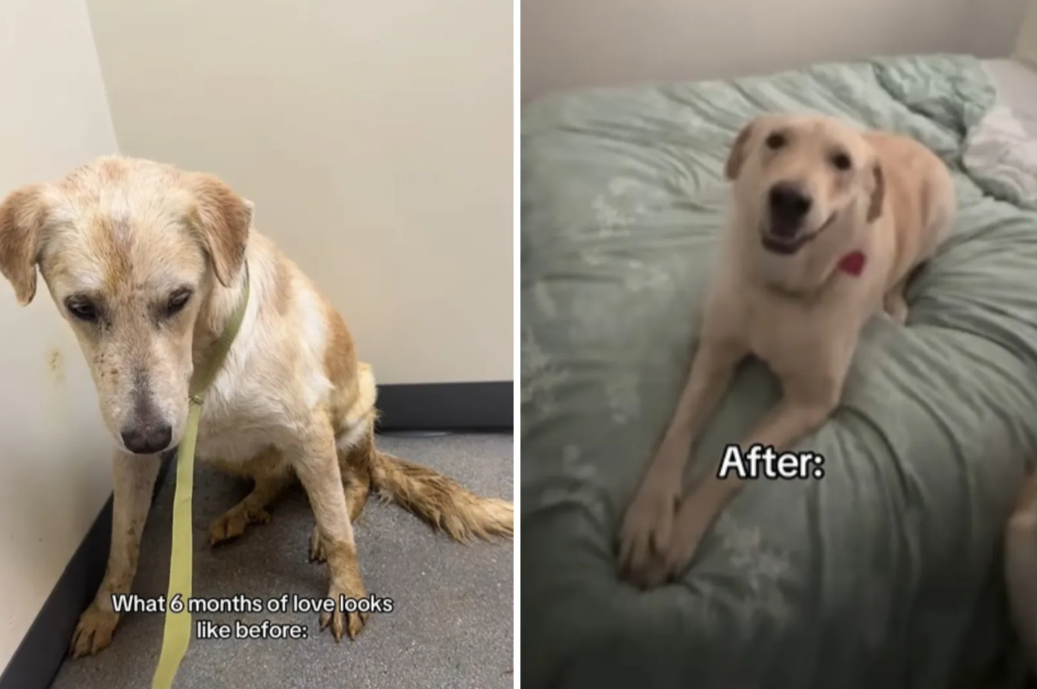
When Annie first arrived at her foster home, she didn’t look like a dog discovering a second chance.
She looked like a dog surviving one.
Quiet. Withdrawn. Careful not to take up too much space in a world that had already taken too much from her.
Rescued from a shelter where she had been on the verge of euthanasia, Annie’s early days in foster care were defined by hesitation.
She avoided eye contact, stayed close to her bed, and moved through her new environment as if she wasn’t sure she was allowed to be part of it.
There was no instant gratitude. No dramatic “happy ending” behavior.
Just stillness.
For the first few months, that stillness didn’t change much.
Her foster family hoped for progress, but it often felt invisible. Annie didn’t play. She didn’t explore.
She didn’t seem to understand that safety was now an option.
And that uncertainty is something many rescue dogs carry with them—not because they’re broken, but because their history taught them to expect instability.
Then, slowly, things began to shift.
Not all at once. Not in a way that would make for a dramatic moment.
But in small decisions only a dog makes when they’re starting to trust the world again.
She started following her foster family from room to room.
She began showing interest in movement around her.
She lingered just a little longer in shared spaces instead of retreating immediately.
And then came the turning point that felt almost too simple to matter at first.
One morning, instead of staying on her bed, Annie got up and followed her foster into the hallway.
Nothing special happened.
But it kept happening.
Over time, those small moments stacked into something bigger.
The dog who once avoided interaction began seeking it. The one who once stayed frozen on her bed began playing.
Her body language softened, her energy lifted, and the quiet tension she carried for so long started to fade.
Six months later, the difference was undeniable.
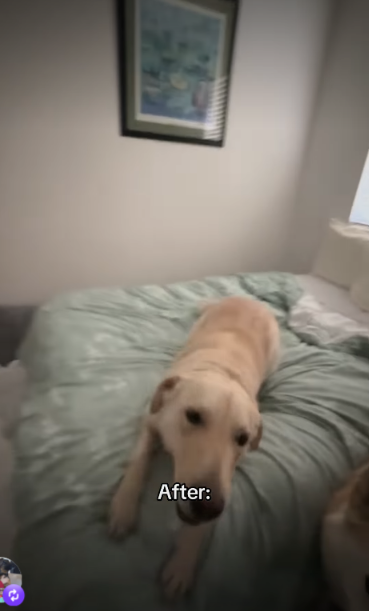
In new footage shared by her foster family, Annie looks almost unrecognizable compared to those early days. She plays. She engages.
She moves through the home with confidence instead of caution.
It’s the kind of transformation that doesn’t feel dramatic in the moment—but becomes overwhelming when you compare where she started.
And that’s what made the video resonate so deeply with people online.
Not because it was a miracle.
But because it wasn’t.
It was patience. Repetition. Time.
And the decision, every single day, to keep showing up for a dog who wasn’t ready yet.
There’s a common idea in rescue work that dogs “bounce back” within a few weeks of being adopted.
And while some do, many others follow a much slower timeline—one that doesn’t fit neatly into expectations.
Annie is one of those dogs.
Her journey didn’t follow a three-day adjustment or a three-week breakthrough.
It followed months of uncertainty before anything began to look like progress.
That’s why her transformation feels so meaningful.
Because it challenges the assumption that healing is quick when love is present.
Sometimes love is present from the start.
And still, healing takes time.
By the six-month mark, Annie wasn’t just adjusting—she was participating in life. Engaging with other dogs. Seeking out affection.
Showing signs of comfort in spaces she once avoided completely.
The reaction from viewers reflected that shift.
People didn’t just see a “before and after.”
They saw patience rewarded in its own language: behavior changing slowly, trust forming quietly, personality returning piece by piece.
And maybe that’s the real takeaway in Annie’s story.
Not that she changed.
But that she was allowed to change at her own pace.
Because rescue isn’t a single moment where everything gets better.
It’s a long series of small moments where nothing gets worse—and eventually, something starts to feel safe.
And for Annie, six months was what it took for safety to stop being a question…
and start becoming her life.