At a children’s center in Georgia, healing doesn’t always begin in a therapist’s office.
Sometimes, it starts on the floor.
With a dog.
A small rescue Mini Australian Shepherd has become an unexpected source of comfort for children who have lived through severe trauma—kids who have experienced neglect, abuse, or instability at home and are now working through recovery in a structured care program.
She doesn’t speak. She doesn’t lecture. She doesn’t analyze.
She simply shows up.
Her name is Robin.
And for many of the children she meets, that consistency alone is powerful.
Inside the center’s therapy program, children are given space to interact with animals in a way that feels natural and unforced.
They can sit beside Robin, talk quietly, or simply exist in the same space without pressure to perform or explain themselves.
For kids who have learned to be guarded around adults, that lack of expectation matters more than it seems.
Robin’s role isn’t to “solve” anything.
It’s to create a sense of safety that doesn’t demand anything in return.
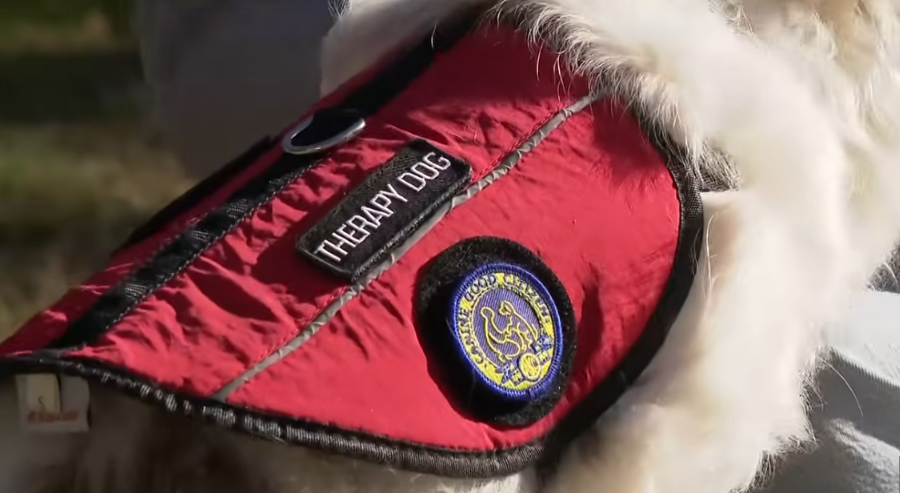
In one-on-one interactions, teenagers have described feeling something they don’t always experience in human relationships right away: trust without conditions.
One teen shared that if Robin could trust her, then maybe she could start trusting again too—a reflection of how animals often become emotional bridges for children learning to reconnect with people.
Another teen, who had experienced deep personal loss, found comfort in Robin’s presence because it connected him to memories of his mother, who loved dogs.
For him, the dog wasn’t just comfort—it was continuity, something familiar in a life that had been disrupted.
That’s the quiet mechanism behind animal-assisted therapy programs like this.
It isn’t about distraction.
It’s about regulation.
Research on therapy dogs consistently shows that calm canine interaction can help reduce anxiety, lower stress responses, and support emotional regulation in children dealing with trauma.
But in practice, what that looks like is far simpler than the science suggests.
A child sitting down.
A dog staying still beside them.
No pressure to talk. No pressure to explain.
Just presence.
Robin also participates in structured sessions alongside trained therapists, becoming part of a broader care system that includes different forms of animal interaction. But even within that structure, her contribution remains fundamentally simple.
She doesn’t direct the session.
She doesn’t lead the healing.
She supports it by being predictable in a world that often hasn’t been.
For children who have experienced instability, that predictability is often the first step toward rebuilding trust—not just in others, but in themselves.
Because when nothing bad happens while they are with the dog… their nervous system starts to learn a new pattern.
Safety can exist.
Connection can exist.
And not everything has to be a threat.
That shift doesn’t happen instantly.
There are no dramatic breakthroughs in a single moment.
Instead, it builds slowly:
A child sitting closer than yesterday.
A hand resting near a dog instead of pulling away.
A quiet conversation that lasts a little longer.
Small signs that something inside is beginning to soften.
Robin’s presence doesn’t erase what the children have been through.
But it gives them something many of them haven’t had consistently before:
A relationship that doesn’t feel unpredictable.
And for children rebuilding trust after trauma, that kind of stability can matter just as much as formal therapy itself.
Not because it replaces it.
But because it makes it possible to engage with it.
In the end, Robin isn’t remembered for dramatic moments.
She’s remembered for the quiet ones.
The still ones.
The ones where a child who once struggled to feel safe… simply stays in the same room a little longer than before.
And sometimes, that’s where healing begins.